
Overview
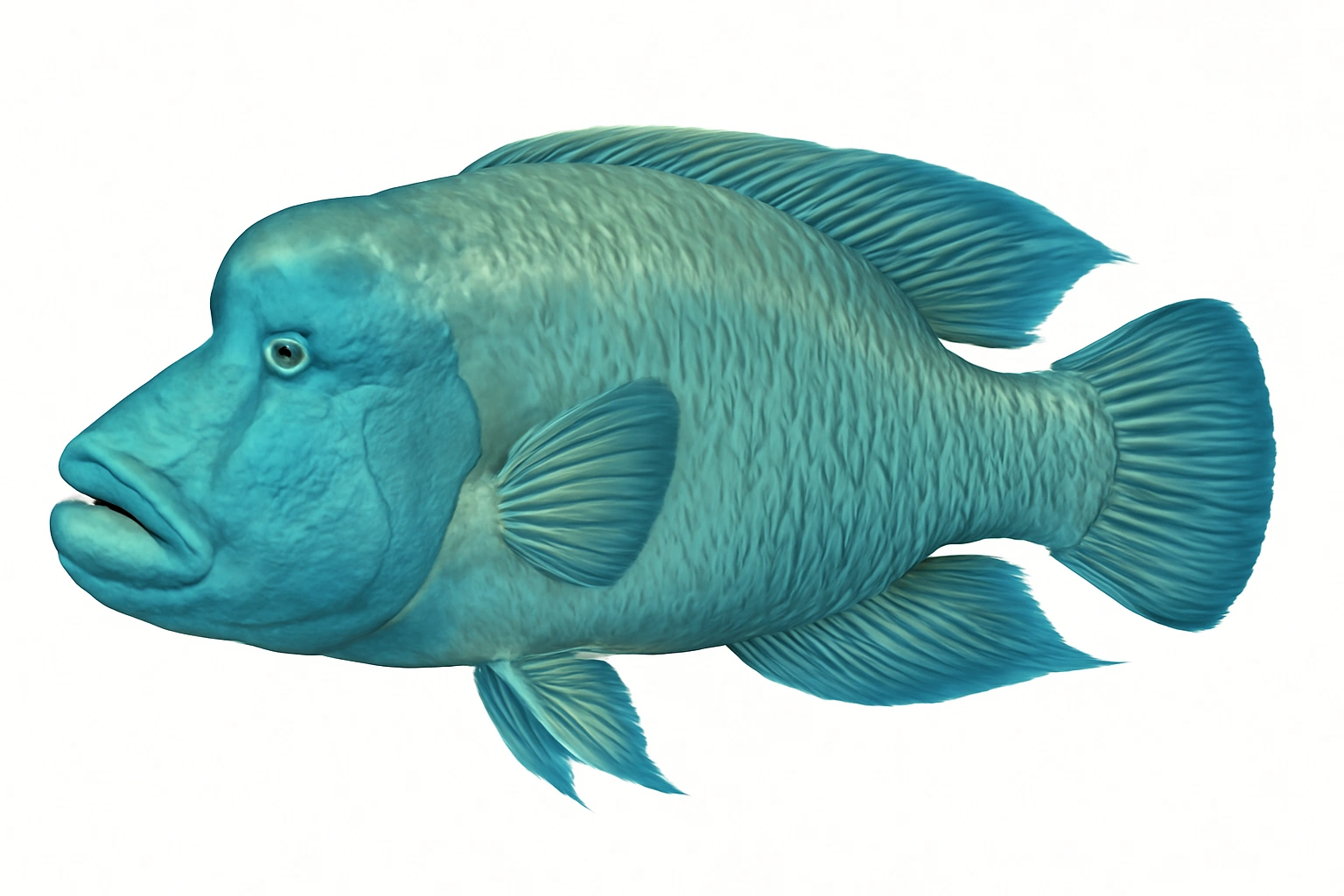
The largest wrasse in the world, iconic of tropical coral reefs. Protected species in many areas.
Identification
- Body
- Massive, elongated body with a prominent head and a high hump on the forehead.
- Colouration
- Bright green-blue with small wavy lines and orange spots on the cheeks.
- Sexual dimorphism
- Males are larger and often more colorful than females.
- Growth
- Slow, taking many years to reach maturity.
Taxonomy
- Family
- Labridae
- Order
- Perciformes
- Class
- Actinopterygii
Related species
Habitat & distribution
- Environment
- Coast, Reefs
- Preferred bottom
- Reef
- Geographic distribution
- Found in coral reefs of the Indian and Pacific Oceans, from the Red Sea to the Tuamotu Islands.
- Micro-habitat
- Hides among corals and cavities in reefs, often near protected crevices.
Prefers areas with lush corals and abundant marine life for rich feeding.
Presence by sea area
Diet
- Primary prey
- mollusks, crustaceans, smaller fish
- Secondary prey
- echinoderms, corals, annelids
- Occasional prey
- jellyfish, algae
- Feeding behaviour
- Feeds primarily during the day, searching among corals and using fleshy lips to extract prey from tight spots.
- Natural predators
- blacktip shark, tiger shark, large groupers
Among the few fish capable of breaking mollusk shells with its powerful jaws.
Behaviour
- Activity
- diurnal
- Social behaviour
- solitary
- Aggressiveness
- low
- Migration
- non-migratory
- Seasonal behaviour
- Changes in feeding behavior are noted with seasonal shifts, leading to more intense activity in warm months.
- Juveniles
- Juveniles tend to stay more hidden among corals to protect themselves from predators.
- Adults
- Adults exhibit dominant and territorial behavior toward individuals of the same species.
Reproduction
- Spawning season
- May, June
- Spawning depth
- between 20 and 60 meters
- Eggs
- Small pelagic eggs, transparent and buoyant.
- Larval stage
- Planktonic larvae drift with currents until they find a safe haven to grow.
- Sexual maturity
- varies between 5 and 7 years
When to catch Humphead wrasse
Activity calendar
Activity by season
Best times
This species shows peak fishing activity in spring, summer and autumn, when the productivity index (FPI) reaches its highest values.
Fishing activity decreases in winter, when conditions are less favourable.
Ideal conditions
Atmospheric pressure
Active, moves on the reef.
Regular activity.
Takes shelter in caves and crevices.
Takes shelter in the reef.
Moves freely on the reef.
More active.
Water temperature
Where to catch it
Best spots
Bottom preference
Spot type
Fishing techniques
Recommended
Other applicable
Recommended baits
Baits by pressure
How to really catch it
The humphead wrasse is an imposing presence on the reef: massive, vividly colored, often seemingly still, with the high forehead that makes it unmistakable. Truly encountering one means reading the reef meter by meter, because this wrasse only lets you get close if you understand where it feeds and where it feels secure.
🐟 Good to know
A solid and lesser-known biological fact is that the humphead wrasse reaches sexual maturity late, between 5 and 7 years of age. This, together with its non-migratory life on coral reefs, makes it especially sensitive to disturbance and helps explain why a careful catch-and-release approach is the most consistent one.
🌊 Where & when
It lives on coral reefs of the Indian and Pacific Oceans, from the Red Sea to the Tuamotu Islands, from shallow water down to significant depths, often near cavities, corals, and protected crevices. It is active during the day and tends to feed more intensely in warm months, with a favorable period especially from March to November; between May and June it spawns between 20 and 60 meters.
🎣 How to really catch it
To fish for it effectively, quiet approach matters more than casting distance. Work the edges of corals, cavities, and crevices with a medium spinning rod, 20-30 lb braid, 40 lb fluorocarbon leader, 3/0 circle hook, and a 20-30 g jighead-style weight, presenting live mollusks, squid, or shrimp naturally and close to the bottom. Once hooked, it often tries immediately to dive back into the reef, so initial control is critical.
💡 The detail that makes the difference
The most defensible practical tip is to focus on active reef cracks in full daylight, not open water. The humphead wrasse feeds by searching among corals and uses its fleshy lips to extract prey from tight shelters: a precise, short, quiet presentation beside a cavity makes far more biological sense than a fast retrieve away from structure.
Catch & handling tips
- Fight
- When hooked, it pulls strongly trying to seek refuge among corals and rocks.
- Handling
- Handle with care to avoid damaging its delicate scales.
- Release
- Release quickly, avoiding prolonged exposure to air, ensuring it swims away on its own.
Curiosities & culture
- Record catches
- Maximum documented size: up to about 229 cm and 191 kg (source: FishBase). There is no official IGFA All-Tackle record: it is a protected species (CITES Appendix II) generally released.
- In the kitchen
- Not recommended for consumption, as it is a protected and vulnerable species.
- Cultural notes
- Seen as a symbol of longevity and strength in indigenous cultures of some Pacific islands.
- Historical notes
- Featured in maritime stories, especially for its connection to coral reefs and its majesty.