
Overview
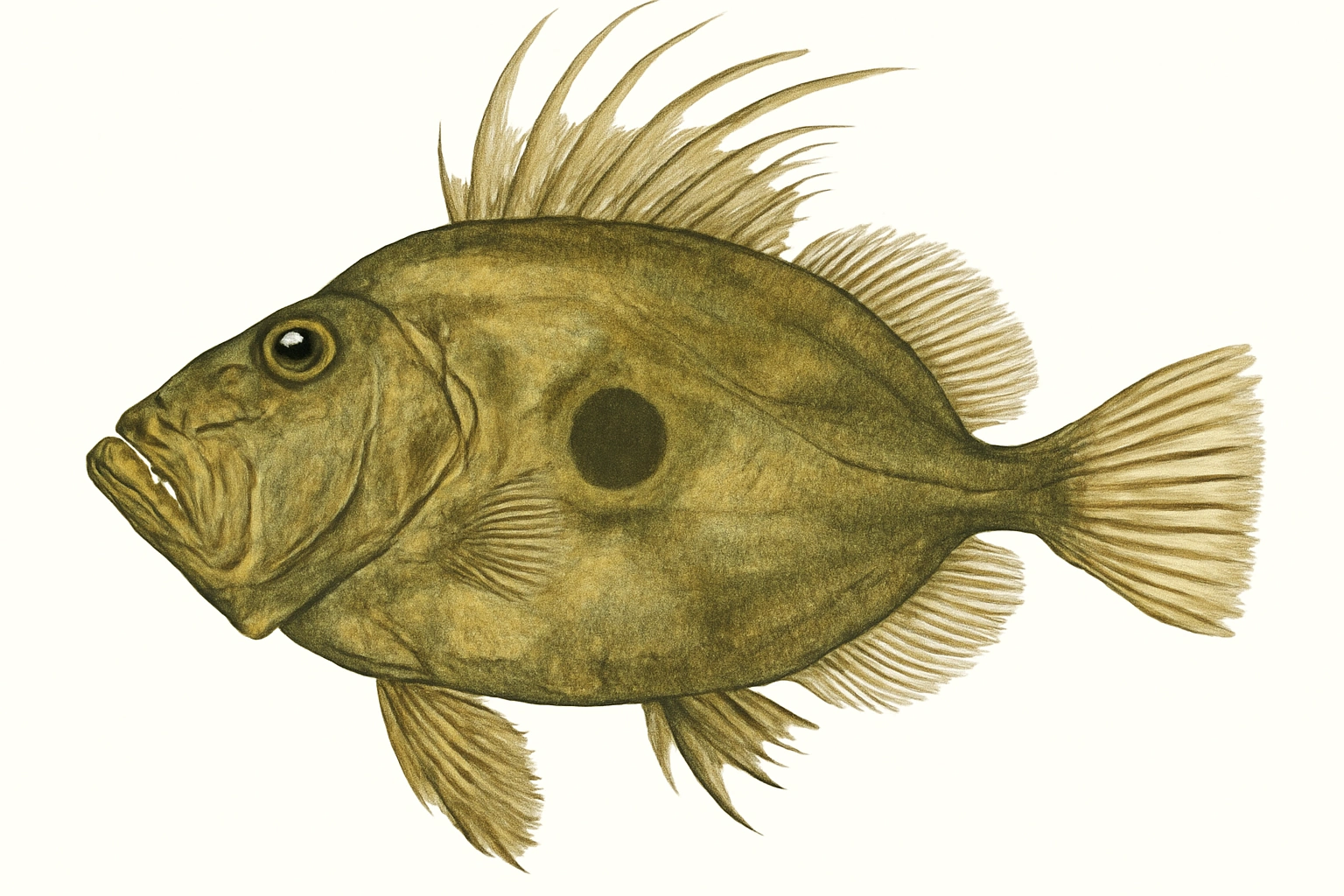
Solitary predator with tall, compressed body. Hunts by slowly approaching prey thanks to its thin profile.
Identification
- Body
- Tall, laterally compressed body with a large, extendable mouth.
- Colouration
- Grayish-yellow body with a large dark spot on the sides.
- Sexual dimorphism
- Absent/not noticeable
- Growth
- slow
Taxonomy
- Family
- Zeidae
- Order
- Zeiformes
- Class
- Actinopterygii
Related species
Habitat & distribution
- Environment
- Coast, Open sea, Reefs
- Preferred bottom
- Sand, Mud, Rock
- Geographic distribution
- Found in the Mediterranean, Eastern Atlantic, from Northern Europe to the African coasts.
- Micro-habitat
- Often found near the bottom in sandy or muddy areas where it can slowly approach prey.
Able to adapt to various types of seabeds, but prefers those rich in prey.
Presence by sea area
Diet
- Primary prey
- small fish, squid, shrimp
- Secondary prey
- crabs, crustaceans, octopuses
- Occasional prey
- jellyfish, annelids
- Feeding behaviour
- A solitary predator that approaches prey slowly, using its thin silhouette to remain unnoticed.
- Natural predators
- sharks, large pelagic fish, dolphins
Its sophisticated hunting techniques allow it to effectively prey on small fish and cephalopods.
Behaviour
- Activity
- crepuscular
- Social behaviour
- solitary
- Aggressiveness
- medium
- Migration
- non-migratory
- Seasonal behaviour
- Activity may decrease during the colder months and vary based on food availability.
- Juveniles
- Younger fish tend to stay closer to the shore and in shallower waters.
- Adults
- Adults venture deeper and develop more sophisticated hunting techniques.
Reproduction
- Spawning season
- May, June
- Spawning depth
- between 20 and 60 meters
- Eggs
- Pelagic eggs, small in size with rapid development.
- Larval stage
- The larval stages are pelagic and develop rapidly.
- Sexual maturity
- varies between 3 and 5 years
When to catch John Dory
Activity calendar
Activity by season
Best times
This species shows peak fishing activity in spring, summer and autumn, when the productivity index (FPI) reaches its highest values.
Ideal conditions
Atmospheric pressure
More active, hunts in shallower water.
Regular activity.
In deep water, less active.
Moves deeper.
Hunts regularly at mid-water.
More active, rises towards surface.
Water temperature
Where to catch it
Best spots
Bottom preference
Spot type
Fishing techniques
Recommended
Other applicable
Recommended baits
Baits by pressure
How to really catch it
John Dory is an elegant, unusual predator, deep-bodied yet razor-thin in profile, able to appear from nowhere over sand, mud, or rock. To target it properly, you have to fish with the same discipline it hunts with: close to the bottom, patiently, waiting for the right moment.
🐟 Good to know
One of its most remarkable features is its protrusible mouth: it can extend forward to suck in prey with great precision. This is perfectly consistent with its hunting style, built on slow approaches and close-range strikes on small fish, squid, and crustaceans.
🌊 Where & when
It lives in the Mediterranean and the eastern Atlantic, from coastal water to open sea, over sandy, muddy, and rocky bottoms, from 5 to 400 meters. It is most worth targeting from spring through autumn, especially from March to November, while activity may drop in colder months. As a crepuscular species, it is most catchable as the light fades; in May and June it spawns between 20 and 60 meters.
🎣 How to really catch it
Trolling is the most concrete way to target it effectively, especially by working slowly over sandy or mixed bottoms near rocky coasts, reefs, and continental shelf edges. The bait should match its diet: live small fish, squid, or shrimp. A 2.10-2.70 m fast-tip rod, 0.35 main line, 0.25 leader, 2/0 circle hooks, and 30-80 g sinkers help keep the presentation low and clean, right where this solitary predator feeds before making quick bursts back toward the bottom.
💡 The detail that makes the difference
The practical secret is simple: keep the bait very close to the bottom, but do not drag it heavily. John Dory often moves tight to the substrate and approaches prey slowly; if the bait stays in its feeding lane and looks natural, you greatly improve the chance that it notices it and takes it cleanly.
Catch & handling tips
- Fight
- Performs quick bursts and attempts to escape towards the bottom.
- Handling
- Handle with care to avoid damaging the delicate skin.
- Release
- Ensure the fish is in good condition and gently submerge it.
Curiosities & culture
- Record catches
- Maximum documented size: up to about 90 cm and 8 kg (source: FishBase). IGFA All-Tackle record: 4.09 kg (9 lb 1 oz).
- In the kitchen
- Valued for the quality of its meat, often used in soups and baked dishes.
- Cultural notes
- Often associated with legends due to the dark spot on its body which is said to be the fingerprint of Saint Peter.
- Historical notes
- Known since ancient times and present in numerous maritime tales and legends.