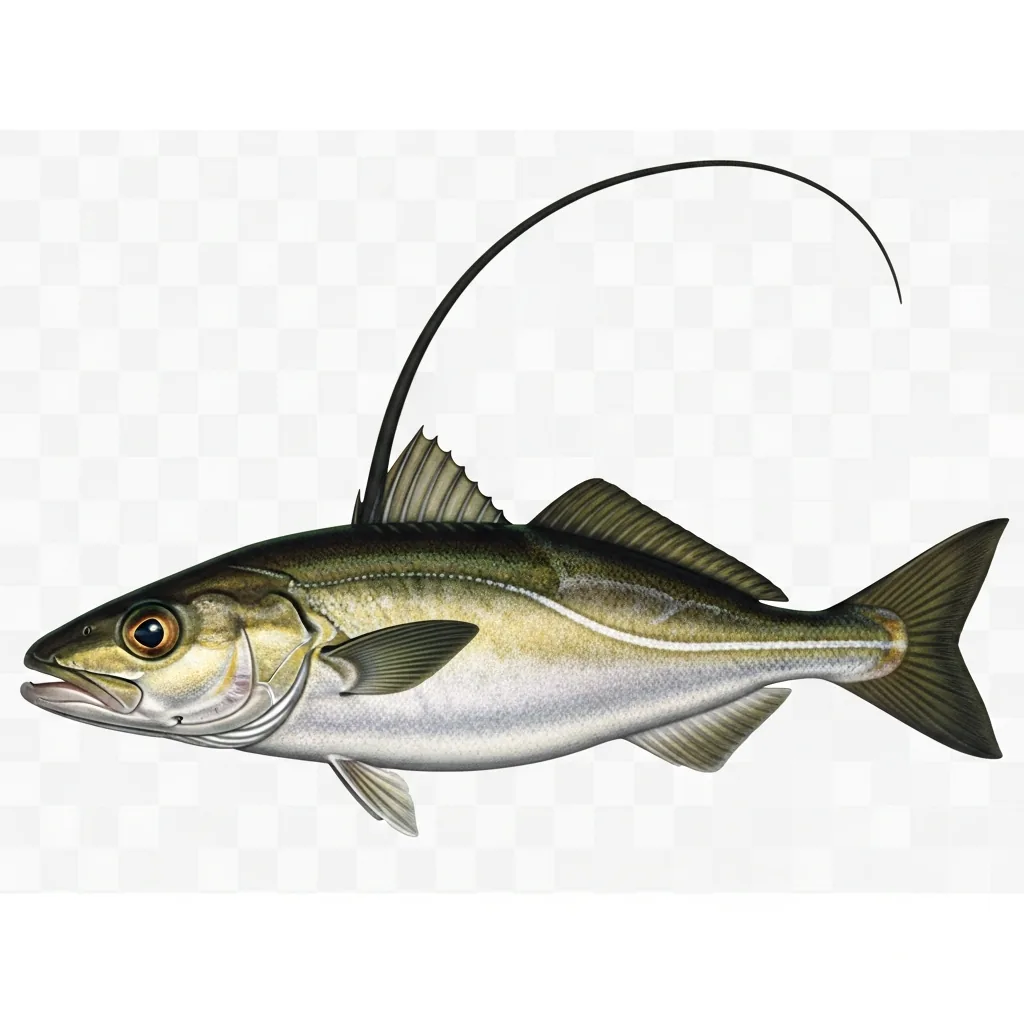

Overview
Active predator of Atlantic waters, hunts in schools near submerged structures.
Identification
- Body
- Elongated body with a pointed head and large mouth.
- Colouration
- Gray-green coloration on the back with golden reflections and a lighter belly.
- Sexual dimorphism
- Absent/not noticeable
- Growth
- average during the first years of life
Taxonomy
- Family
- Gadidae
- Order
- Gadiformes
- Class
- Actinopterygii
Related species
Habitat & distribution
- Environment
- Coast, Open sea, Reefs
- Preferred bottom
- Rock, Reef
- Geographic distribution
- Found along the northeastern Atlantic coasts from the Bay of Biscay to Norway, including the British Isles.
- Micro-habitat
- Hides among submerged structures and hunts near reefs or rocky outcrops.
Avoids sandy bottom areas, preferring rocky bottoms for abundant shelter and nourishment.
Presence by sea area
Diet
- Primary prey
- herrings, cods, cephalopods
- Secondary prey
- shrimp, crabs, haddocks
- Occasional prey
- squid, small bottom fish, starfish
- Feeding behaviour
- Hunts in schools, actively chasing prey near the surface or close to submerged structures.
- Natural predators
- seals, dolphins, orcas, large predatory fish
Opportunistic predator, quickly adapts to the seasonal availability of prey.
Behaviour
- Activity
- diurnal
- Social behaviour
- small_groups
- Aggressiveness
- medium
- Migration
- Seasonal movements based on temperatures and prey availability.
- Seasonal behaviour
- Moves away from the coasts in search of cooler waters in warmer months. Approaches in autumn for spawning.
- Juveniles
- Often forms small schools near the shore.
- Adults
- Mostly moves in small groups, occupying larger territories.
Reproduction
- Spawning season
- February, March
- Spawning depth
- between 40 and 60 meters
- Eggs
- Small pelagic eggs carried by currents.
- Larval stage
- Pelagic larvae develop rapidly in warmer waters between April and May.
- Sexual maturity
- 3-4 years
When to catch Pollack
Activity calendar
Activity by season
Best times
This species shows peak fishing activity in spring, summer and autumn, when the productivity index (FPI) reaches its highest values.
Fishing activity decreases in winter, when conditions are less favourable.
Ideal conditions
Atmospheric pressure
Very aggressive, attacks on surface.
Medium activity, hunts at mid-water.
Stationary, less reactive.
Water temperature
Where to catch it
Best spots
Bottom preference
Spot type
Fishing techniques
Recommended
Other applicable
Recommended baits
Baits by pressure
How to really catch it
The pollack is a quick, powerful predator, with an elongated body and a wide mouth built to chase prey between rock and open water. When it starts hunting around reefs and submerged structure, an apparently empty drift can suddenly turn into a hard, decisive strike.
🐟 Good to know
A useful identification feature is the absence of a chin barbel, unlike other gadids. Its eggs are pelagic and drift with the currents, and the larvae are pelagic as well, developing in warmer waters between April and May.
🌊 Where & when
It lives along the northeastern Atlantic coasts from the Bay of Biscay to Norway, including the British Isles, mainly over rocky bottoms, reefs and outcrops between 30 and 200 meters. It hides among submerged structures and hunts around their edges; in warmer months it tends to move away from the coast, while from autumn it comes closer again. Spawning takes place between February and March, at 40 to 60 meters.
🎣 How to really catch it
To target it effectively, vertical jigging is the most concrete method around submerged reefs, rocky ledges and artificial structures. A metal jig worked close to the structure, with clean lifts and constant bottom control, suits a predator that feeds on small fish and cephalopods. Bottom fishing and trolling with sardines or squid also work; from shore, spinning with artificials is useful where juveniles move close in.
💡 The detail that makes the difference
The most practical secret is to fish the margin between rock and open water, not the middle of the structure. Pollack hides in cover but hunts around outcrops and can rise toward the surface when chasing baitfish, so presenting the lure along that boundary makes the take more likely.
Catch & handling tips
- Fight
- Fights strongly, using the current to its advantage.
- Handling
- Handle carefully to prevent muscle damage.
- Release
- Quickly release in deep water to ensure recovery.
Curiosities & culture
- Record catches
- Maximum documented size: up to about 130 cm and 18 kg (source: FishBase). IGFA All-Tackle record: 12.47 kg (27 lb 6 oz), caught at Salcombe, England (UK), in 1986.
- In the kitchen
- Used in fish and chips dishes, often prized for its white and delicate meat in fries and grills.
- Cultural notes
- Known in Scottish fishermen's legends as a reliable source of seasonal fishing.
- Historical notes
- Fishing for Pollack was an important part of England's and Norway's maritime traditions in the 19th century.