
Overview
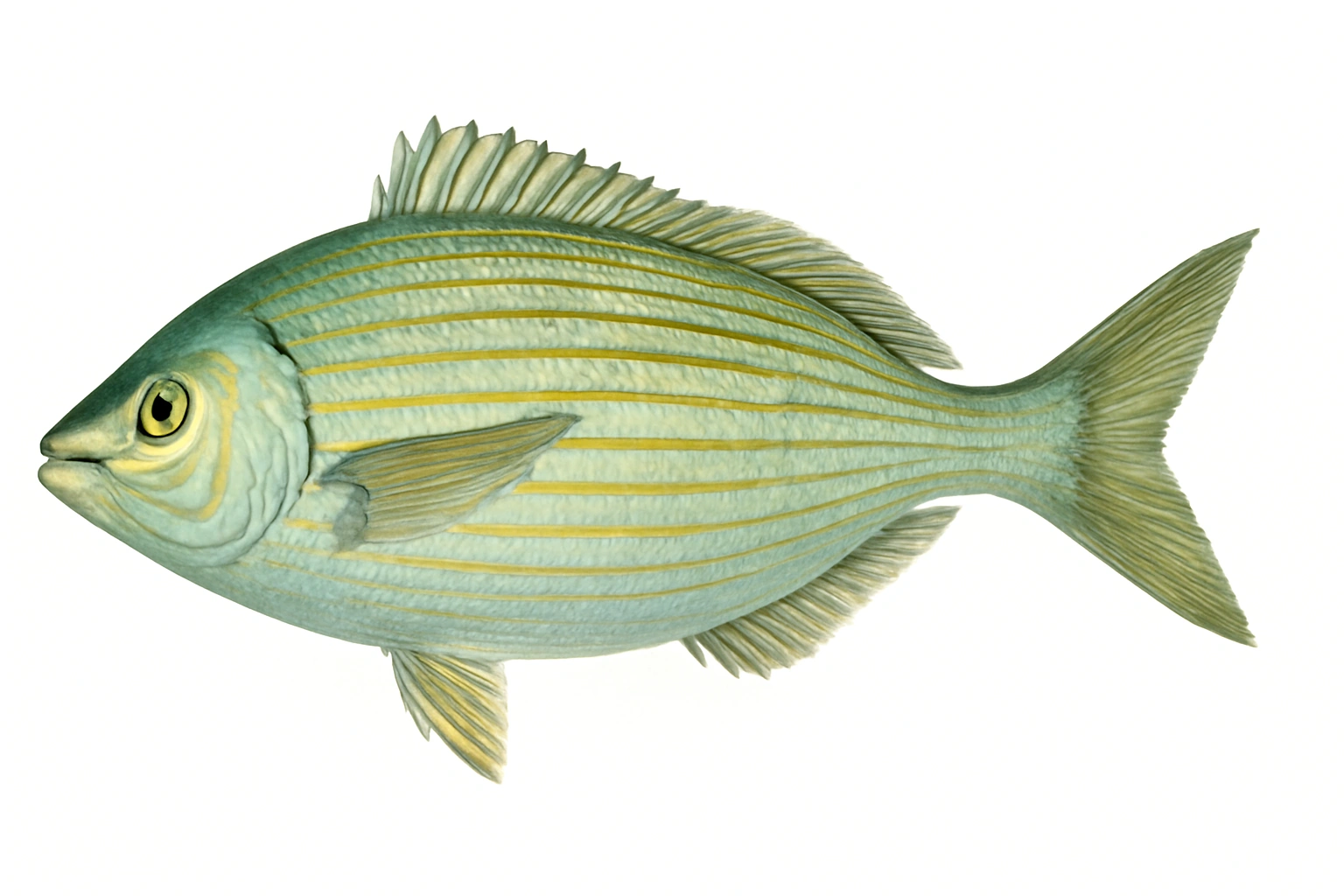
Herbivorous fish of posidonia meadows and reefs. Moves in schools and feeds mainly on algae.
Identification
- Body
- The body is elongated and laterally compressed.
- Colouration
- The coloration is silvery with golden longitudinal stripes.
- Sexual dimorphism
- Absent/not very noticeable
- Growth
- Moderate, develops in the early years of life.
Taxonomy
- Family
- Sparidae
- Order
- Perciformes
- Class
- Actinopterygii
Related species
Habitat & distribution
- Environment
- Coast, Reefs
- Preferred bottom
- Posidonia, Reef, Rock
- Geographic distribution
- Found in the Mediterranean Sea, along the eastern Atlantic coast from Western Europe to South Africa.
- Micro-habitat
- Often hides among seagrass beds and along reefs to evade predators.
Prefers seabeds rich in marine vegetation as shelter and food source.
Presence by sea area
Diet
- Primary prey
- algae, diatoms, seagrass
- Secondary prey
- small crustaceans, protozoa, phytoplankton
- Occasional prey
- organic detritus, plant materials, small mollusks
- Feeding behaviour
- Feeds mainly during the day, grazing on algae and seagrass from rocks and seagrass beds.
- Natural predators
- groupers, sea bass, bluefish, amberjacks
Adapted to a predominantly plant-based diet with occasional small invertebrates.
Behaviour
- Activity
- diurnal
- Social behaviour
- large_schools
- Aggressiveness
- low
- Migration
- Resident with small seasonal movements along the coast.
- Seasonal behaviour
- In summer, tends to move to deeper waters to avoid high surface temperatures.
- Juveniles
- Juveniles form small groups near the shores for protection.
- Adults
- Adults join large schools that move together for feeding.
Reproduction
- Spawning season
- May, June, July
- Spawning depth
- between 5 and 20 meters
- Eggs
- Pelagic eggs with a very small diameter, typical of marine fish.
- Larval stage
- The larvae are planktonic and develop near the surface.
- Sexual maturity
- 3-4 years
When to catch Salema
Activity calendar
Activity by season
Best times
This species shows peak fishing activity in spring, summer and autumn, when the productivity index (FPI) reaches its highest values.
Ideal conditions
Atmospheric pressure
Active, feeds on rocks.
Regular activity.
Less active, moves away.
Reduced activity.
Good activity along reefs.
More active, feeds intensely.
Water temperature
Where to catch it
Best spots
Bottom preference
Spot type
Fishing techniques
Recommended
Other applicable
Recommended baits
Baits by pressure
How to really catch it
The salema has the quiet pace of a coastal herbivorous fish, yet when a school moves onto a seagrass bed the whole bottom seems to come alive at once. Spotting those golden stripes and understanding how it feeds is what turns a doubtful nibble into a clean capture.
🐟 Good to know
Unlike many seabream targeted by anglers, the salema feeds mainly on algae, diatoms, and seagrass, grazing by day over rocks and seagrass meadows. That diet explains its small mouth and the often delicate way it tests a bait.
🌊 Where & when
You find it along coasts, reefs, and rocky areas, from very shallow water down to 70 meters, often hidden among seagrass and rock. It is a diurnal, resident species with small coastal seasonal movements; from March to November it is consistently present, while in summer it tends to move deeper. Between May and July it spawns from 5 to 20 meters.
🎣 How to really catch it
To catch it for real, light bottom fishing is the most concrete approach: a light spinning rod, 0.25 nylon, a 20 lb fluorocarbon leader, small hooks, and a light sinker, keeping the bait working close to seagrass and rocks. Algae and paque are the most consistent baits with its diet, while shrimp and marine worms can work on fish feeding more opportunistically. Fish by day, and follow the school rather than waiting for a single fish.
💡 The detail that makes the difference
The practical detail that changes everything is not lifting the bait away from living bottom. The salema grazes on rocks and seagrass beds, so a presentation resting naturally and almost still is more believable than one held too high or dragged around: when the school passes, the chance often happens there, just a few centimeters above the vegetation.
Catch & handling tips
- Fight
- The Salpa tends to swim quickly in schools when caught.
- Handling
- Handle with care to avoid fin damage.
- Release
- Release gently into the water to avoid stressing the fish.
Curiosities & culture
- Record catches
- Maximum documented size: up to about 51 cm and 3 kg (source: FishBase). There is no official IGFA All-Tackle record for this species.
- In the kitchen
- Primarily consumed grilled or baked, popular along the Mediterranean coasts.
- Cultural notes
- Known for potential hallucinogenic effects if consumed, occasionally mentioned in seafaring tales.
- Historical notes
- Known since ancient times for its schooling behavior and delicate taste.