
Overview
Highly valued fish in Australian and New Zealand waters.
Identification
- Body
- Body laterally compressed, with a prominent head and large mouth.
- Colouration
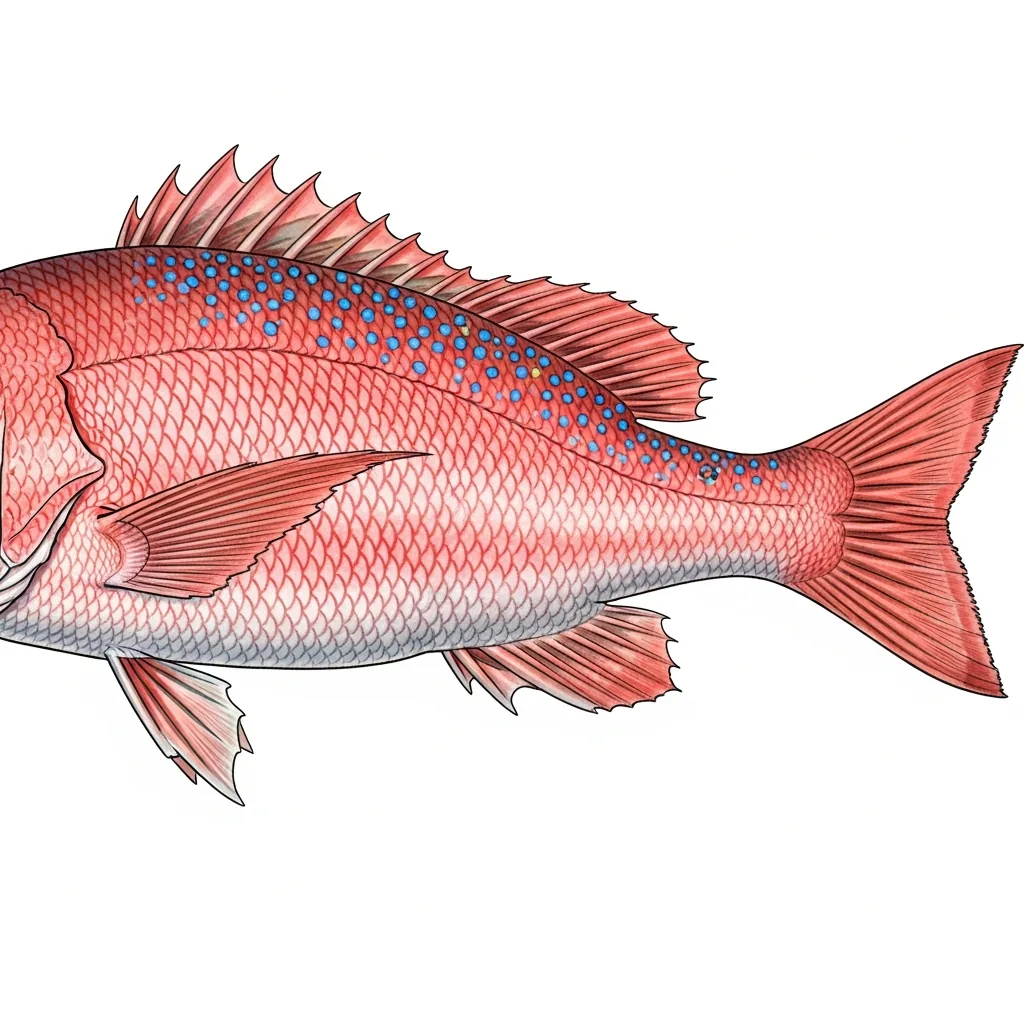
- Coloration ranges from pink to red with silvery reflections, often with blue spots on the sides.
- Sexual dimorphism
- Absent/not pronounced
- Growth
- Slow, takes several years to reach maturity.
Taxonomy
- Family
- Sparidae
- Order
- Perciformes
- Class
- Actinopterygii
Related species
Habitat & distribution
- Environment
- Coast, Reefs, Open sea
- Preferred bottom
- Rock, Sand, Reef
- Geographic distribution
- Distributed along the coasts of Australia and New Zealand. Often found in temperate seas.
- Micro-habitat
- Takes refuge among rocks and often near coral reefs.
Prefers rocky seabeds or areas with barriers for hunting.
Presence by sea area
Diet
- Primary prey
- crustaceans, mollusks, small fish
- Secondary prey
- polychaetes, algae, sea urchins
- Occasional prey
- jellyfish, zooplankton
- Feeding behaviour
- Opportunistic predator, feeds on the sea floor by digging or tearing prey from the rocks.
- Natural predators
- sharks, large marine predators, humans
Its diet varies widely depending on the environment and season.
Behaviour
- Activity
- diurnal
- Social behaviour
- small_groups
- Aggressiveness
- medium
- Migration
- Some populations migrate seasonally along the coast.
- Seasonal behaviour
- During summer, its activity increases, often approaching the shore to spawn.
- Juveniles
- Juveniles tend to stay in protected, shallow areas.
- Adults
- Adults move more freely and may form small schools.
Reproduction
- Spawning season
- October, November, December
- Spawning depth
- between 10 and 50 meters
- Eggs
- Pelagic eggs, small and buoyant
- Larval stage
- Larvae are planktonic and quickly develop in shallow coastal areas.
- Sexual maturity
- 4-5 years
When to catch Australian snapper
Activity calendar
Activity by season
Best times
This species shows peak fishing activity in spring, summer and autumn, when the productivity index (FPI) reaches its highest values.
Fishing activity decreases in winter, when conditions are less favourable.
Ideal conditions
Atmospheric pressure
Very active, leaves the reef.
Regular activity.
Stationary near the reef.
Water temperature
Where to catch it
Best spots
Bottom preference
Spot type
Fishing techniques
Recommended
Other applicable
Recommended baits
Baits by pressure
How to really catch it
The Australasian snapper is a rock-loving fish with an unmistakable profile: prominent head, wide mouth, reddish flanks marked with blue spots, and large eyes that seem to read every detail of the bottom. When it turns on over reefs and rocky edges, it delivers a firm take and a determined fight that keeps the angler locked onto the rod.
🐟 Good to know
One well-documented biological feature of Pagrus auratus is that it lays pelagic eggs that are small and buoyant. After hatching, the larvae remain planktonic and develop quickly in shallow coastal areas, while juveniles later tend to hold in protected, shallow habitats.
🌊 Where & when
It lives along coasts, reefs, and open sea over rock, sand, and reef bottoms from 5 to 200 meters, with a clear preference for rocky shores, coral reefs, and mixed ground where it can shelter among rocks. It is diurnal and often most catchable from the warmer months through November; in summer its activity increases and it moves closer to shore to spawn, between 10 and 50 meters.
🎣 How to really catch it
To catch it for real, the most concrete approach is fishing natural or live bait close to the bottom, working rocky shores, reefs, and sandy bottoms with a sturdy spinning rod, 20-30 lb braid, a 40 lb fluorocarbon leader, a single 3/0 hook, and running sinkers. Shrimp, sardines, and squid match its opportunistic diet of crustaceans, mollusks, and small fish; the presentation should stay low, right in the band where it digs and tears food from the rocks.
💡 The detail that makes the difference
The small edge that matters is choosing mixed bottom where sand meets rock. That is where this sparid can shift from cover to feeding, digging into the bottom or taking prey fixed to the rocks: a running-sinker rig set naturally along that transition line matches the way it truly searches for food.
Catch & handling tips
- Fight
- Known for its vigor, pulls decisively and can fight for a long time.
- Handling
- Handle with care, as it has sharp spines on its back.
- Release
- Release gently, avoiding internal injury.
Curiosities & culture
- Record catches
- Maximum documented size: up to about 130 cm and 20 kg (source: FishBase). IGFA All-Tackle record: 17.2 kg (37 lb), caught in New Zealand in 1992.
- In the kitchen
- Valued roasted or grilled, in dishes like 'Snapper in salt crust'.
- Cultural notes
- Present in Maori culture as a symbol of good fortune.
- Historical notes
- Traditionally fished in Australia, celebrated at various local festivals.