
Overview
Schooling fish living on rocky and mixed bottoms, very combative.
Identification
- Body
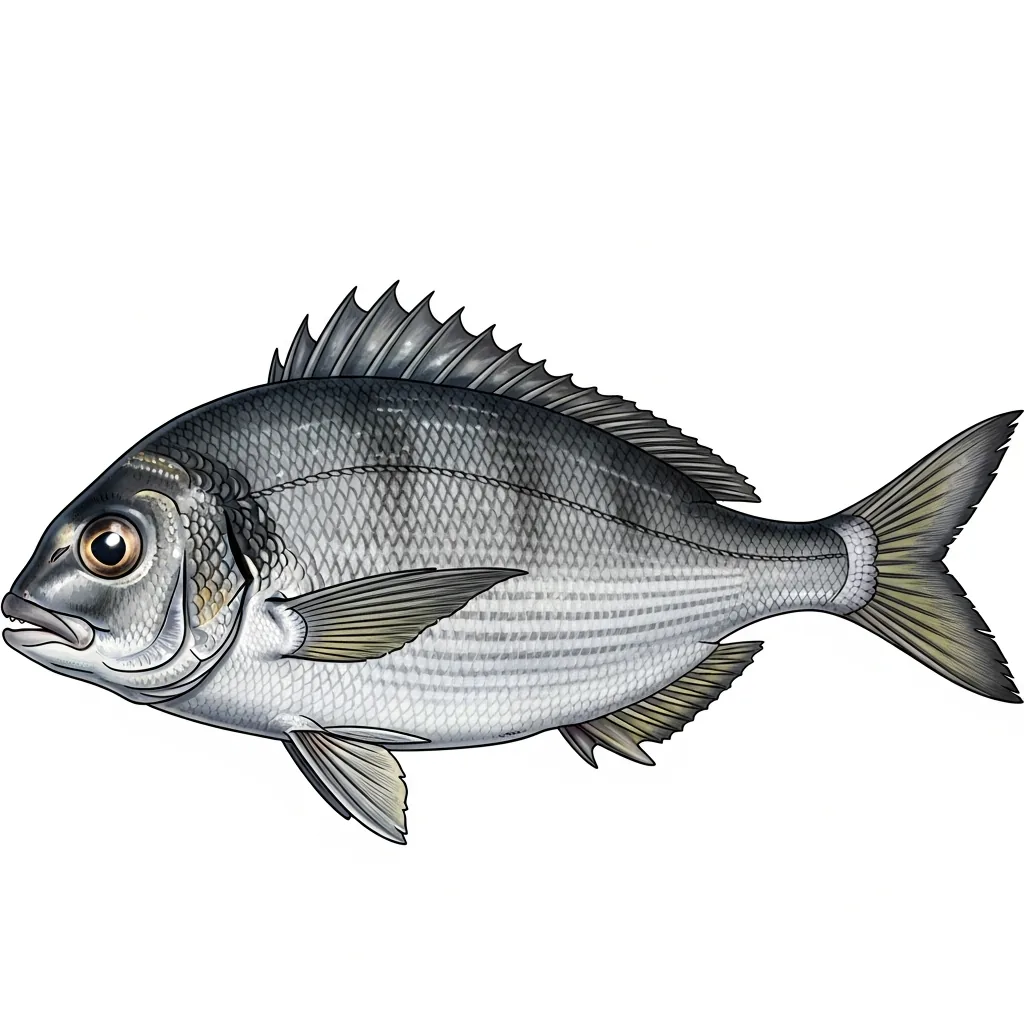
- Oval and laterally compressed body, with a large head.
- Colouration
- Bluish-gray hue with silver reflections and dark transverse bands.
- Sexual dimorphism
- None/slightly noticeable
- Growth
- Medium with steady growth in favorable environments
Taxonomy
- Family
- Sparidae
- Order
- Perciformes
- Class
- Actinopterygii
Related species
Habitat & distribution
- Environment
- Coast, Reefs
- Preferred bottom
- Rock, Reef
- Geographic distribution
- Found in the Mediterranean Sea, eastern Atlantic Ocean, from the British Isles to Senegal.
- Micro-habitat
- Hides among rock crevices and near mixed seabeds, often close to seagrass meadows.
Their presence often indicates a healthy marine ecosystem.
Presence by sea area
Diet
- Primary prey
- crustaceans, mollusks, annelids
- Secondary prey
- small fish, seaweed, zooplankton
- Occasional prey
- carcasses, benthic invertebrates
- Feeding behaviour
- Opportunistic predator, feeds mainly on the bottom but can also feed mid-water, using its mouth to dig.
- Natural predators
- seabream, groupers, dolphins, sharks
Diet varies based on available local prey.
Behaviour
- Activity
- diurnal
- Social behaviour
- small_groups
- Aggressiveness
- medium
- Migration
- Non-migratory
- Seasonal behaviour
- During the spawning season, moves closer to the shore, whereas in colder months, tends to move to deeper waters.
- Juveniles
- Form small schools for protection and food.
- Adults
- Often solitary or in small groups, can be territorial in feeding areas.
Reproduction
- Spawning season
- April, May, June
- Spawning depth
- Between 20 and 60 meters
- Eggs
- Small, transparent pelagic eggs.
- Larval stage
- Larvae are pelagic and move towards coastal areas as they grow.
- Sexual maturity
- Varies between 2 and 4 years
When to catch Black sea bream
Activity calendar
Activity by season
Best times
This species shows peak fishing activity in spring, summer and autumn, when the productivity index (FPI) reaches its highest values.
Fishing activity decreases in winter, when conditions are less favourable.
Ideal conditions
Atmospheric pressure
Very active and less wary.
Regular activity.
Stays near rocks.
Water temperature
Where to catch it
Best spots
Bottom preference
Spot type
Fishing techniques
Recommended
Other applicable
Recommended baits
Baits by pressure
How to really catch it
The black seabream is a bottom-dwelling sparid with a compressed body and striped livery, able to appear suddenly among rock, seagrass and mixed reefs. When it moves onto a feeding area or picks up a bait near the bottom, it alternates caution with sharp, forceful runs, making every capture feel bigger than its size suggests.
🐟 Good to know
During reproduction it releases small, transparent pelagic eggs, and its larvae are pelagic as well before gradually moving toward coastal areas as they grow. This is a key part of its biology, linking open-water stages to the rocky coastal habitats commonly used later by adults.
🌊 Where & when
You find it along coasts and reefs, over rocky or mixed bottoms from 5 to 150 meters, often close to crevices, structures and seagrass meadows. It is most worth targeting from March to November; from April to June, during the spawning season, it comes closer to shore, while in colder months it tends to move deeper.
🎣 How to really catch it
The most reliable way to target it is bottom fishing over rocky ground, submerged reefs and the edges of seagrass, keeping the bait working close to the bottom and not too far from its shelter. Shrimp, squid, clams and strips of sardine match its opportunistic diet; a medium-length stiff rod, 8-12 lb line, abrasion-resistant fluorocarbon leader and size 2-4 hooks help manage the strike and its quick surges.
💡 The detail that makes the difference
The soundest practical edge is to maintain clean bottom contact without over-weighting the rig: black seabream feeds mainly low over rock and benthic invertebrates, and a setup just balanced to the seabed keeps the bait natural exactly where it looks for food. An abrasion-resistant leader matters when the fish immediately tries to dive back into rough ground.
Catch & handling tips
- Fight
- Very combative, puts up a vigorous fight and can break the line with quick bursts.
- Handling
- Handle with care to avoid stress and damage to fins.
- Release
- Release quickly into the water, preferably using a wet landing net.
Curiosities & culture
- Record catches
- Maximum documented size: up to about 60 cm and 1.9 kg (source: FishBase). IGFA All-Tackle record: about 1.9 kg (4 lb 3 oz), set in 2002.
- In the kitchen
- In Italy, it is favored for soups and grilling, often cooked with aromatic herbs and lemon.
- Cultural notes
- Often depicted in local Mediterranean art for its beauty and resilience.
- Historical notes
- Historically caught with shore-drawn nets, it was considered a delicacy in Roman times.