
Overview
Large tropical pelagic, fast and powerful, one of the most coveted catches.
Identification
- Body
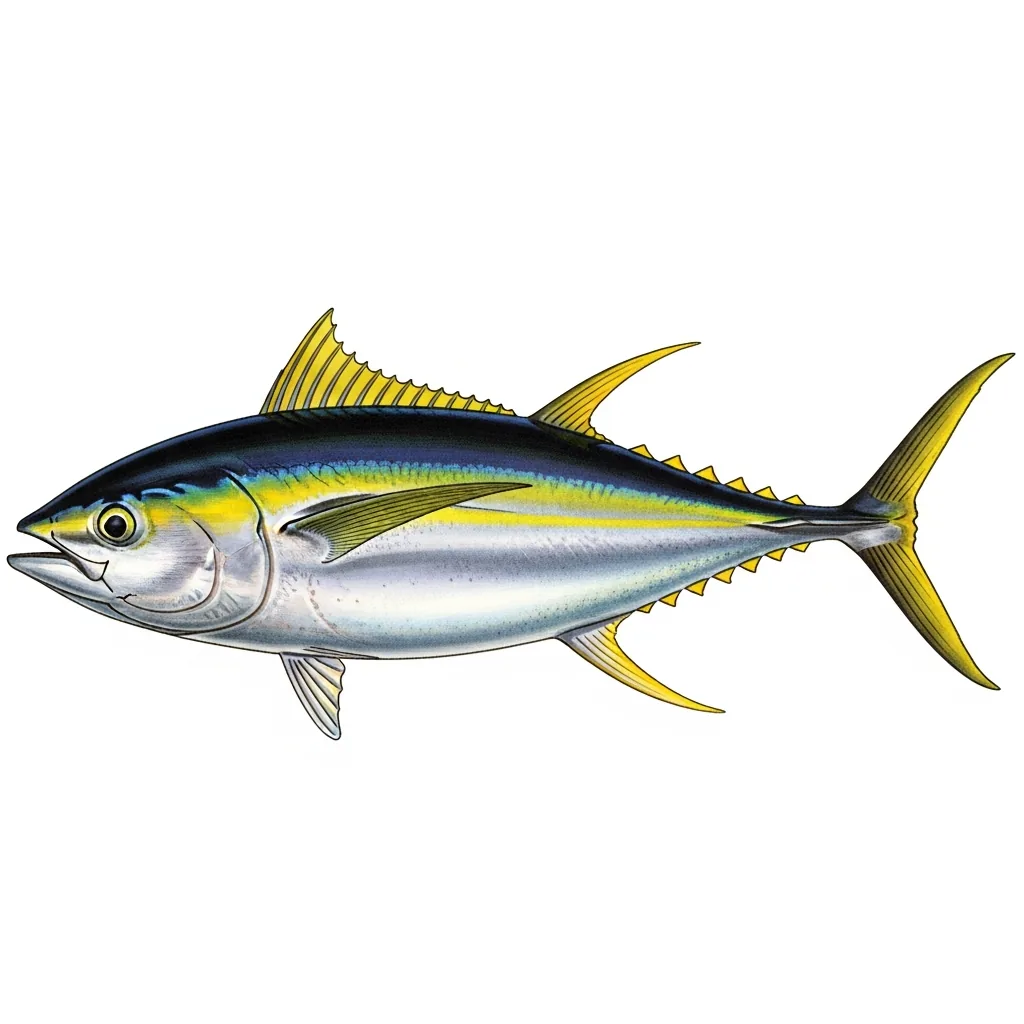
- Streamlined and hydrodynamic body, with very pronounced crescent-shaped fins.
- Colouration
- Dark blue body on the back, silvery on the sides and belly, with bright yellow fins.
- Sexual dimorphism
- Absent/not prominent
- Growth
- Rapid, particularly in juvenile stages to quickly reach large sizes.
Taxonomy
- Family
- Scombridae
- Order
- Scombriformes
- Class
- Actinopterygii
Related species
Habitat & distribution
- Environment
- Open sea
- Preferred bottom
- Pelagic
- Geographic distribution
- Widespread in all tropical and subtropical waters of the Atlantic, Pacific, and Indian Oceans.
- Micro-habitat
- Often found near schools of other pelagic fish and in nutrient-rich currents.
Favors open waters but doesn't shy away from coastal incursions if prey is plentiful.
Presence by sea area
Diet
- Primary prey
- fish, squid, crustaceans
- Secondary prey
- cephalopods, small tunas, sardines
- Occasional prey
- jellyfish, plankton
- Feeding behaviour
- Active hunter both day and night, capable of rapid surface bursts to catch prey.
- Natural predators
- sharks, larger succeeding tunas, humans
Uses hunting strategies that vary with prey size and environmental conditions.
Behaviour
- Activity
- diurnal
- Social behaviour
- large_schools
- Aggressiveness
- medium
- Migration
- Migratory, follows ocean currents and nutrient upwelling seasons.
- Seasonal behaviour
- Often approaches the coast in warmer months and follows food-rich currents.
- Juveniles
- Juveniles form large schools and move in warm surface waters.
- Adults
- Adults can form large pelagic schools and are often found with other pelagic species.
Reproduction
- Spawning season
- June, July, August
- Spawning depth
- Pelagic, at the surface over open tropical waters.
- Eggs
- Pelagic eggs, small and transparent, floating freely in water columns.
- Larval stage
- Larvae are pelagic, delicate and transparent, with rapid growth in food-rich waters.
- Sexual maturity
- 2-3 years
When to catch Yellowfin tuna
Activity calendar
Activity by season
Best times
This species shows peak fishing activity in spring, summer and autumn, when the productivity index (FPI) reaches its highest values.
Fishing activity decreases in winter, when conditions are less favourable.
Ideal conditions
Atmospheric pressure
Feeding frenzy on surface.
Active hunting at mid-water.
Deeper, less predictable.
Water temperature
Where to catch it
Best spots
Bottom preference
Spot type
Fishing techniques
Recommended
Other applicable
Recommended baits
Baits by pressure
How to really catch it
Yellowfin tuna is the wide breath of the open sea: a fusiform, fast, heavily muscled pelagic fish, with yellow fins flashing in the blue. When it moves onto active currents and bait concentrations, fishing ignites suddenly and demands sharp eyes, proper tackle, and a cool head.
🐟 Good to know
One real and remarkable feature of this species is its pelagic reproduction: it releases small, transparent eggs that remain suspended in the tropical water column. The larvae are also pelagic, delicate, and transparent, and grow quickly where food is abundant.
🌊 Where & when
Look for it in open water, from the surface down to about 300 meters, especially over oceanic ridges, nutrient-rich currents, and areas holding abundant small fish and other pelagics. It is migratory and follows food; it becomes more reachable in warmer months, with a peak from March to November and a greater chance of approaching the coast. From June to August it spawns at the surface over open tropical waters.
🎣 How to really catch it
To truly fish for it, trolling is the most concrete approach: a powerful trolling rod, 30-50 lb braid, and an 80 lb fluorocarbon leader give you control when it surges off in hard runs and quick lateral swings. Work live baitfish, squid, or feathered artificials along active currents and feeding edges; drifting and spinning with jigs also work well where the school is hunting high in the water.
💡 The detail that makes the difference
The practical edge is to read the whole scene, not just the sounder: yellowfin often associate with schools of other pelagics and with concentrated forage. If you find alive water, defined current, and tight bait, stay on that band with disciplined passes before deciding to leave the area.
Catch & handling tips
- Fight
- Energetic fight with powerful runs and fast lateral thrashing.
- Handling
- Use gloves and pliers, avoid excessive physical stress.
- Release
- Ensure the fish is lively, releasing it quickly with minimal handling.
Curiosities & culture
- Record catches
- Maximum documented size: up to about 239 cm and 200 kg (source: FishBase). IGFA All-Tackle record: 200.94 kg (443 lb), caught by Earl Gill IV at Cabo San Lucas (Mexico) in 2024.
- In the kitchen
- Widely used in Japanese cuisine as sashimi, and Mediterranean cuisine grilled or canned.
- Cultural notes
- Symbol of power and speed, often celebrated in coastal maritime art.
- Historical notes
- For centuries, yellowfin tuna has been central to the nautical economies of many coastal civilizations.