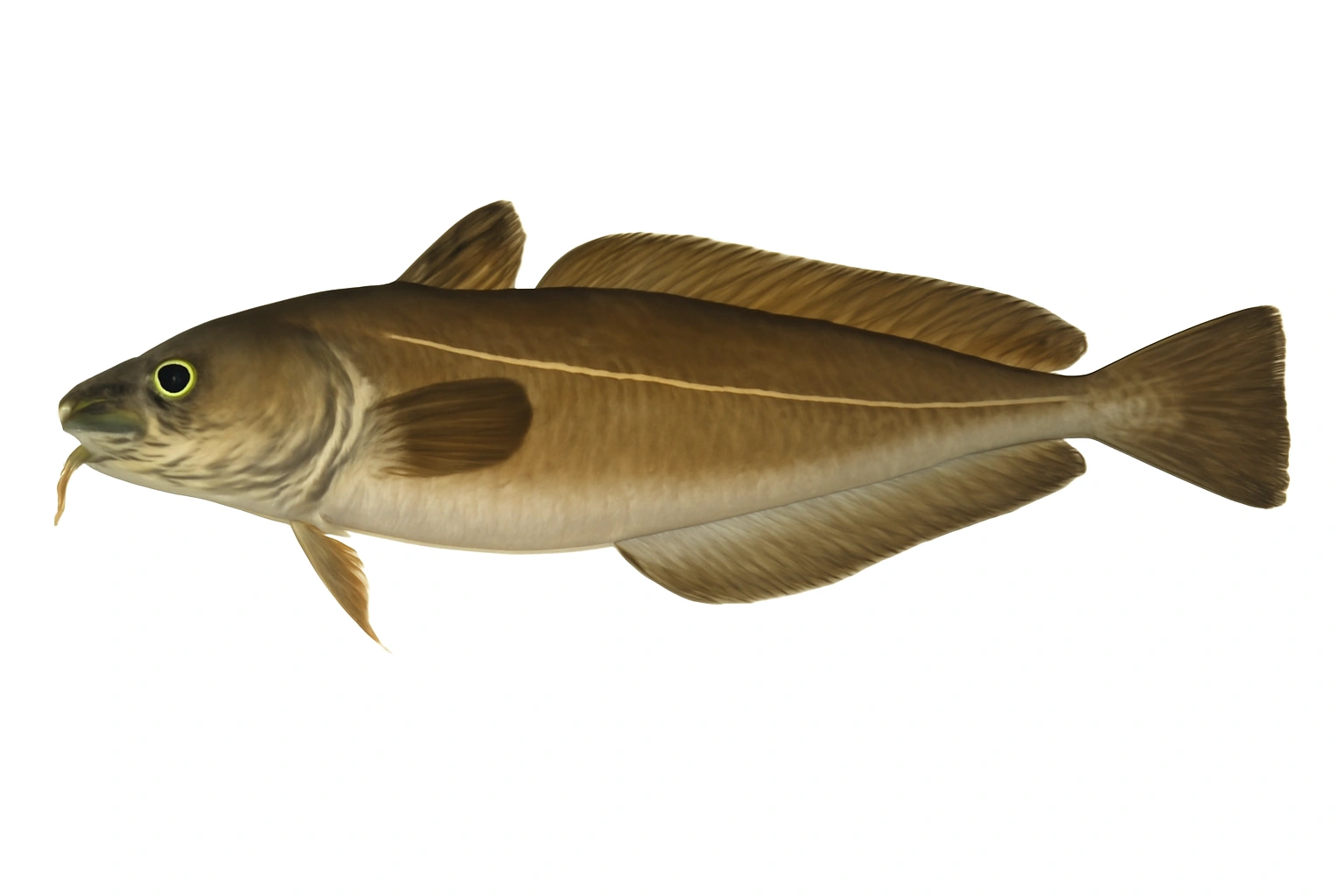

Overview
Deep-water fish of Nordic waters, lives on rocky bottoms. Prized meat highly appreciated in Scandinavia.
Identification
- Body
- It has an elongated and robust body with a single long dorsal fin.
- Colouration
- Usually light brown with shades tending towards gray or white on the belly.
- Sexual dimorphism
- Not very evident
- Growth
- medium, grows more rapidly in its early years
Taxonomy
- Family
- Lotidae
- Order
- Gadiformes
- Class
- Actinopterygii
Related species
Habitat & distribution
- Environment
- Deep sea, Reefs
- Preferred bottom
- Rock, Gravel
- Geographic distribution
- Widespread in the northern Atlantic, from the shores of Labrador to Iceland and Norway.
- Micro-habitat
- Hides among rocks and crevices of the seabed.
Often found in crevices of underwater cliffs, prefers environments rich in shelters.
Presence by sea area
Diet
- Primary prey
- crustaceans, annelids, gastropods
- Secondary prey
- echinoderms, small fish, amphipods
- Occasional prey
- squid, polychaetes
- Feeding behaviour
- Predominantly hunts at night, using its barbels to sense prey in the rocky bottom.
- Natural predators
- sharks, seals, large pelagic predators
Feeding depends on the availability of benthic invertebrates.
Behaviour
- Activity
- nocturnal
- Social behaviour
- solitary
- Aggressiveness
- low
- Migration
- resident
- Seasonal behaviour
- Slight increase in activity during the spawning season in spring.
- Juveniles
- Juveniles tend to live in shallower waters compared to adults.
- Adults
- Adults settle in areas with deep rocky bottoms.
Reproduction
- Spawning season
- April, May
- Spawning depth
- between 200 and 600 meters
- Eggs
- Demersal eggs, non-sticky and small in size
- Larval stage
- Pelagic larvae, planktonic in the early stages
- Sexual maturity
- varies between 3 and 7 years
When to catch Tusk
Activity calendar
Activity by season
Best times
This species shows peak fishing activity in spring, summer and autumn, when the productivity index (FPI) reaches its highest values.
Fishing activity decreases in winter, when conditions are less favourable.
Ideal conditions
Atmospheric pressure
Active on bottom.
Regular activity.
Less active.
Less active.
Feeds regularly.
More active.
Water temperature
Where to catch it
Best spots
Bottom preference
Spot type
Fishing techniques
Recommended
Other applicable
Recommended baits
Baits by pressure
How to really catch it
The tusk is a bottom fish of the North Atlantic, shy and solitary, living where light fades and rock takes over. To find it for real, you have to think like it does: get down onto hard bottom, close to crevices, and fish patiently where the seabed seems still but is full of hidden life.
🐟 Good to know
One notable biological feature of the tusk is the chin barbel, which it uses to detect prey on rocky bottom while feeding mostly at night. It is a very fitting adaptation for its deep benthic life, among crustaceans, annelids, and small organisms hidden among stones and gravel.
🌊 Where & when
It lives over rocky and gravel bottoms from 50 to 1000 meters, often around deep reefs, banks, underwater cliffs, and submarine valleys in the North Atlantic, from Labrador to Iceland and Norway. Adults occupy deep rocky areas and remain resident; it becomes more interesting from spring into autumn, with a slight rise in activity in April and May during spawning between 200 and 600 meters.
🎣 How to really catch it
The most practical way to target it is a bottom rig lowered precisely onto rock and gravel, close to cracks and submerged structure. A sturdy bottom rod, 30-50 lb mono or braid, a 60 lb fluorocarbon leader, a 3/0 circle hook, and a pear sinker or sliding weight let you present sardines, shrimp, or fish offal effectively, keeping the bait close to the seabed where tusk search for food.
💡 The detail that makes the difference
The tip that really matters is not letting the bait drift away from hard bottom: tusk feed on benthic prey and use the barbel to locate them among rocks and crevices. When hooked, it often tries to dive straight back into the stones with short runs downward, so contact should stay direct and your response immediate, without giving away unnecessary line.
Catch & handling tips
- Fight
- Tends to make short dives toward the bottom and tries to hide among the rocks.
- Handling
- Use gloves to avoid scratches from scales and spines.
- Release
- Ensure the fish can swim away vigorously after release.
Curiosities & culture
- Record catches
- Maximum documented size: up to about 120 cm and 30 kg (source: FishBase). IGFA All-Tackle record: 17.20 kg (37 lb 14 oz), caught by Anders Jonasson off Sørøya (Norway).
- In the kitchen
- White and firm meat, used in soups and baked dishes.
- Cultural notes
- Valued in Scandinavian cuisine, considered a symbol of abundance.
- Historical notes
- Historically caught with deep-sea longlines in the North Sea, part of Viking culinary tradition.