
Overview
Large solitary predator of deep rocky environments. Territorial and long-lived, symbol of the Mediterranean.
Identification
- Body
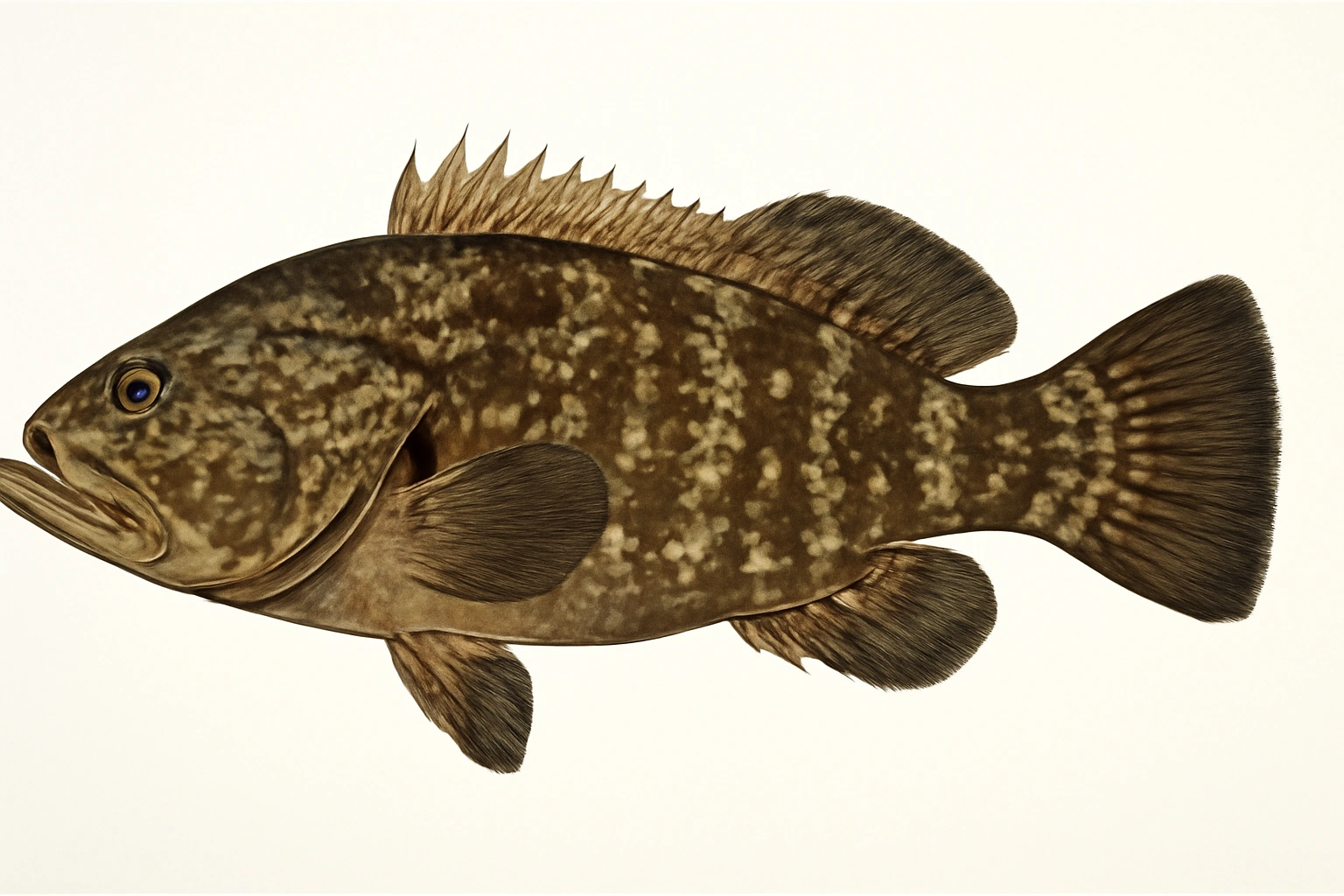
- Massive and elongated body, with a large head and prominent mouth.
- Colouration
- Brown-reddish coloration with lighter spots and patches, particularly noticeable in juveniles.
- Sexual dimorphism
- Absent/weakly evident
- Growth
- Slow, reaching considerable sizes over many years.
Taxonomy
- Family
- Serranidae
- Order
- Perciformes
- Class
- Actinopterygii
Related species
Habitat & distribution
- Environment
- Coast, Reefs, Pelagic
- Preferred bottom
- Rock, Coralligenous
- Geographic distribution
- Found in the Mediterranean Sea, the eastern Atlantic, from the coast of Portugal to South Africa, and occasionally in the Indian Ocean.
- Micro-habitat
- Often hides in caves and rocky crevices, emerging to hunt.
Prefers rocky coasts and reefs where they can easily find shelter.
Presence by sea area
Diet
- Primary prey
- fish, crustaceans, octopus
- Secondary prey
- squid, cuttlefish, gastropods
- Occasional prey
- small sharks, crabs
- Feeding behaviour
- Solitary opportunistic predator, primarily hunting at dawn and dusk, using ambush techniques to catch prey.
- Natural predators
- sharks, large marlin, humans
Adapts to the availability of prey in different seasons.
Behaviour
- Activity
- diurnal
- Social behaviour
- solitary
- Aggressiveness
- medium
- Migration
- Residential, while others migrate vertically based on season and temperature.
- Seasonal behaviour
- During summer, tends to approach shallower depths for spawning.
- Juveniles
- Stay closer to the coast and hide among the rocks.
- Adults
- Residential, patrol a large territory that they defend from conspecifics.
Reproduction
- Spawning season
- June, July, August
- Spawning depth
- between 20 and 60 meters
- Eggs
- Pelagic, transparent, and small eggs.
- Larval stage
- Planktonic larvae that are part of the pelagic plankton until metamorphosis.
- Sexual maturity
- ranges between 4 and 7 years
When to catch Dusky grouper
Activity calendar
Activity by season
Best times
This species shows peak fishing activity in spring, summer and autumn, when the productivity index (FPI) reaches its highest values.
Ideal conditions
Atmospheric pressure
Leaves den more often, actively hunts near the bottom.
Regular activity, stays near den.
Stays in den, less active.
Reduced activity, stays in den.
Good activity, comes out to hunt regularly.
Very active before storms, hunts outside den.
Water temperature
Where to catch it
Best spots
Bottom preference
Spot type
Fishing techniques
Recommended
Other applicable
Recommended baits
Baits by pressure
How to really catch it
The dusky grouper is the silent lord of the rocks: heavy-bodied, camouflaged, almost motionless until it decides to strike. Once you learn to read caves, cuts and crevices, you realize quickly that catching it is not about speed, but about being exactly where it lives.
🐟 Good to know
The dusky grouper is born female and may later become male as it grows: a well-documented case of protogynous hermaphroditism. That makes large specimens especially important for the species’ reproduction.
🌊 Where & when
It lives over rocky and coralligenous bottoms, along coasts, reefs and submerged reliefs, generally from 20 to 200 meters, with a clear preference for caves and rocky cracks from which it emerges to hunt. It becomes more relevant from spring to autumn; in summer it often moves shallower, and from June to August it spawns between 20 and 60 meters.
🎣 How to really catch it
The most practical way to target it is deep bottom fishing, lowered with precision tight to rocky crevices, caves and ledges. A sturdy bottom rod, 0.40-0.50 monofilament, stainless steel leader, 1/0 circle hook and a 50-150 g sinker give control where it matters; squid and octopus are highly credible baits, with sardine or crab useful when you want strong scent and presence near the bottom.
💡 The detail that makes the difference
The real edge is not searching blindly across barren rock, but placing the bait at the mouth of the shelter. The dusky grouper is a solitary ambush predator and often launches from a specific hideout: if the bait stays still or barely moves in front of that opening, you are truly fishing its strike zone.
Catch & handling tips
- Fight
- Strong and stubborn, they try to hide in crevices during the fight.
- Handling
- Handle carefully to avoid dorsal spines and pectoral fins.
- Release
- Gently remove the hook and release quickly to ensure survival.
Curiosities & culture
- Record catches
- Maximum documented size: up to about 150 cm and 60 kg (source: FishBase). IGFA All-Tackle record: 24.3 kg (53 lb 12 oz), caught by Philip Greenman at Angra dos Reis, Rio de Janeiro (Brazil).
- In the kitchen
- Valued in fish soups and roasts, particularly appreciated as a key ingredient in traditional Italian dishes like 'cernia al forno'.
- Cultural notes
- Symbol of strength and resilience in Mediterranean folklore.
- Historical notes
- Historically subjected to intense fishing due to its commercial value and exceptional size.