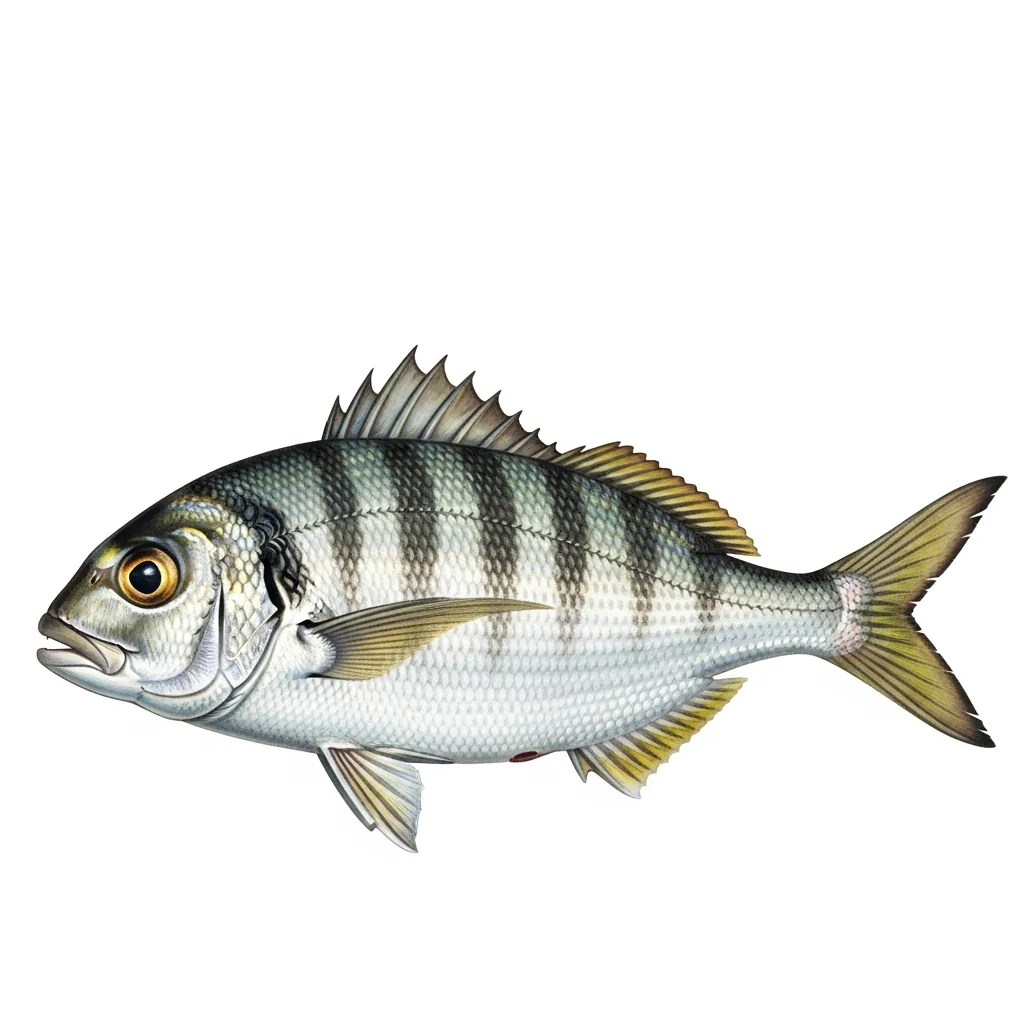

Overview
Robust and wary species, loves deep reefs and mixed bottoms.
Identification
- Body
- The body is oval and laterally compressed, with a pointed snout.
- Colouration
- Silvery gray with dark vertical bands, especially prominent in juveniles.
- Sexual dimorphism
- Absent/not noticeable
- Growth
- Moderate, continuous growth during early years.
Taxonomy
- Family
- Sparidae
- Order
- Perciformes
- Class
- Actinopterygii
Related species
Habitat & distribution
- Environment
- Coast, Reefs, Open sea
- Preferred bottom
- Rock, Sand, Gravel
- Geographic distribution
- Central and Eastern Mediterranean, sometimes along the Eastern Atlantic coasts.
- Micro-habitat
- Hides among rocks and in reef crevices.
Prefers areas with rocks and crevices to hide from predators.
Presence by sea area
Diet
- Primary prey
- crustaceans, mollusks, annelids
- Secondary prey
- algae, small fish, echinoderms
- Occasional prey
- zooplankton, fish eggs
- Feeding behaviour
- Feeds by scraping the surface of rocks and substrate for prey, often in small groups.
- Natural predators
- anglerfish, barracuda, dusky grouper, bottlenose dolphin
Diversified diet thanks to its adaptability to environmental changes.
Behaviour
- Activity
- diurnal
- Social behaviour
- small_groups
- Aggressiveness
- medium
- Migration
- Resident with minor seasonal movement.
- Seasonal behaviour
- During summer months, tends to move to shallower waters in search of food.
- Juveniles
- The young gather in sheltered areas near reefs.
- Adults
- Adults congregate in small groups near rocky formations.
Reproduction
- Spawning season
- May, June, July
- Spawning depth
- between 50 and 100 feet
- Eggs
- Small demersal eggs attached to rocks.
- Larval stage
- Larvae are pelagic, carried by currents until settling into coastal shelters.
- Sexual maturity
- 4-5 years
When to catch Sharpsnout sea bream
Activity calendar
Activity by season
Best times
This species shows peak fishing activity in spring, summer and autumn, when the productivity index (FPI) reaches its highest values.
Ideal conditions
Atmospheric pressure
Very active and less wary.
Regular activity.
Stays near deep rocks.
Normal activity, fewer surface bites.
Good conditions, feeds regularly.
Increases activity before bad weather. Good time to fish.
Water temperature
Where to catch it
Best spots
Bottom preference
Spot type
Fishing techniques
Recommended
Other applicable
Recommended baits
Baits by pressure
How to really catch it
The sharpsnout seabream is a bottom fish with an elegant outline and a pointed snout, built for places where rock, sand, and light meet. It gives nothing away: you catch it only when you picture its paths through cracks, ledges, and mixed bottom patches, and that is where real fishing begins.
🐟 Good to know
One true biological detail of the species is the early cycle of eggs and larvae: the eggs are demersal and remain attached to rocks, while the larvae are pelagic and drift with currents before settling in coastal shelters. It is a life stage that ties the species closely both to the seabed and to open-water dynamics.
🌊 Where & when
Look for it along coasts, reefs, and open sea over rock, sand, and gravel bottoms, generally from 5 to 50 meters, especially near cliffs, rocky reefs, and mixed areas where it can slip into crevices. It is most worthwhile from March to November; in summer it often moves shallower to feed, while from May to July it spawns between 15 and 30 meters.
🎣 How to really catch it
For sharpsnout seabream, the most concrete approach is bottom fishing, placing the bait precisely along the live edge of rocks or on mixed sandy ground next to reefs. A 7-9 ft medium-action rod, 8-10 lb monofilament, a 20 lb fluorocarbon leader, strong size 2-4 hooks, and a 1-2 oz olive sinker give control and feel. Shrimp, mussels, annelids, and squid pieces match its natural diet of crustaceans, mollusks, and annelids.
💡 The detail that makes the difference
A practical secret is to work the first fishable meter outside the hide, not inside it. The sharpsnout seabream feeds by scraping rocks and substrate, and when alarmed it tries to dive back into cover: presenting the bait just outside crevices or on the rock-to-sand edge keeps you in its feeding lane, but with more room to stop it before it wedges itself in.
Catch & handling tips
- Fight
- Becomes combative and can evade capture among rocks.
- Handling
- Handle with care to avoid damaging its scales.
- Release
- Handle gently and release quickly back into the water.
Curiosities & culture
- Record catches
- Maximum documented size: up to about 60 cm and 1.7 kg (source: FishBase). There is no official global IGFA All-Tackle record for this species.
- In the kitchen
- Primarily valued in fish soups and grilled.
- Cultural notes
- In some Mediterranean cultures, a symbol of cunning and agility.
- Historical notes
- Known since ancient times for its taste and the challenge it presents to anglers.