
Overview
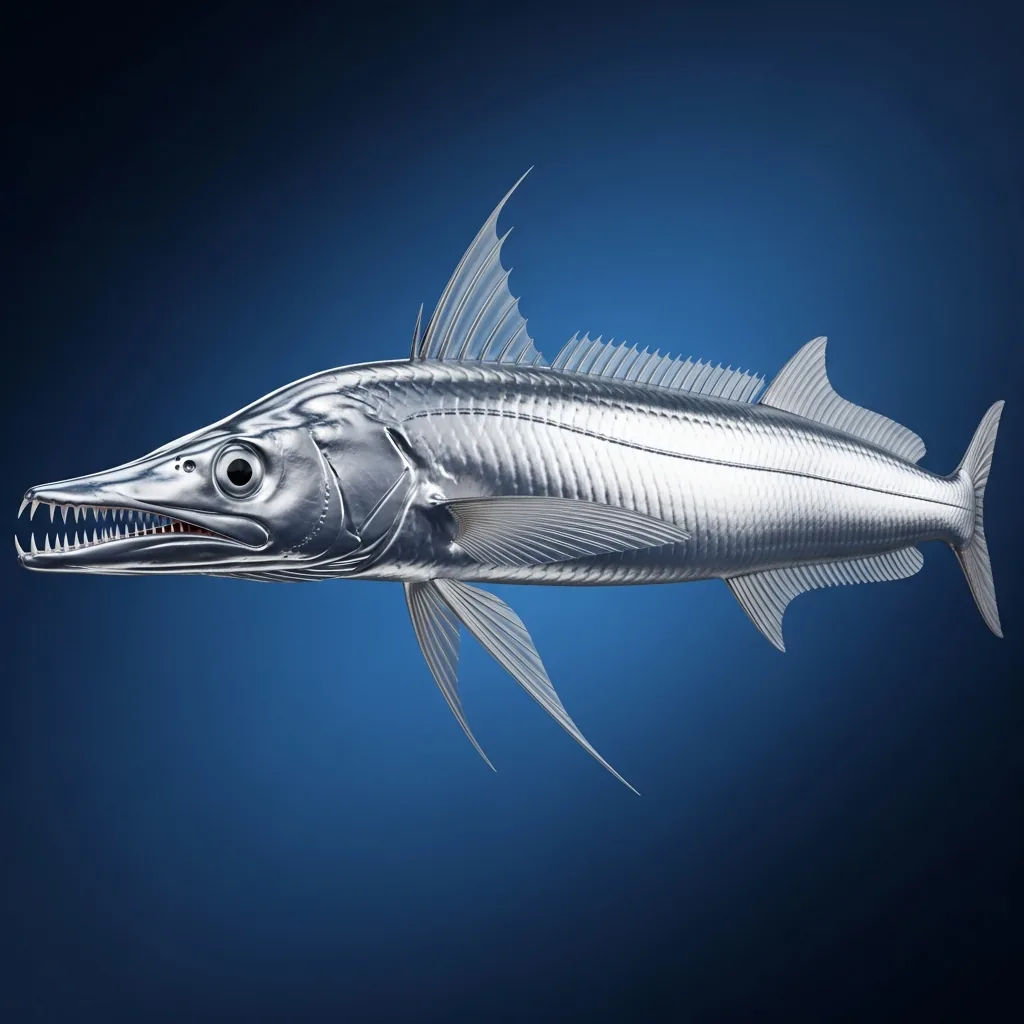
Silvery nocturnal predator, lives deep and rises at night.
Identification
- Body
- Long, laterally compressed body resembling a blade.
- Colouration
- Silvery body with metallic sheen, dark pelvic fins and back.
- Sexual dimorphism
- Absent/not very noticeable
- Growth
- Fast, especially in early years
Taxonomy
- Family
- Trichiuridae
- Order
- Perciformes
- Class
- Actinopterygii
Related species
Habitat & distribution
- Environment
- Deep sea, Coast
- Preferred bottom
- Sand, Mud
- Geographic distribution
- Found in the Mediterranean Sea and along the Atlantic coasts from Europe to Africa.
- Micro-habitat
- Often rests near the bottom during the day, rising at night to hunt.
Prefers deep environments with low light near the seabed.
Presence by sea area
Diet
- Primary prey
- small fish, crustaceans, cephalopods
- Secondary prey
- shrimp, squid, crabs
- Occasional prey
- fish larvae, small invertebrates
- Feeding behaviour
- Nocturnal predator, actively hunts its food moving to shallower waters at night.
- Natural predators
- sharks, large predatory fish, marine mammals
Opportunistic predator, known for being effective during nighttime foraging.
Behaviour
- Activity
- nocturnal
- Social behaviour
- solitary
- Aggressiveness
- medium
- Migration
- Sedentary, but may perform daily vertical movements.
- Seasonal behaviour
- Active year-round but closer to shore in warmer waters.
- Juveniles
- Young are more vulnerable and tend to stay in shallower waters.
- Adults
- Adults prefer deeper waters and are skilled solitary hunters.
Reproduction
- Spawning season
- June, July, August, September
- Spawning depth
- between 300 and 100 meters
- Eggs
- Pelagic eggs, small, transparent.
- Larval stage
- Pelagic larvae, live in plankton until they grow.
- Sexual maturity
- 3-4 years
When to catch Silver scabbardfish
Activity calendar
Activity by season
Best times
This species shows peak fishing activity in spring, autumn and winter, when the productivity index (FPI) reaches its highest values.
Ideal conditions
Atmospheric pressure
Very active.
Regular activity.
Stays deep.
Water temperature
Where to catch it
Best spots
Bottom preference
Spot type
Fishing techniques
Recommended
Other applicable
Recommended baits
Baits by pressure
How to really catch it
The scabbardfish has the profile of a living blade: long, silvery, with large eyes and a mouth built to seize prey in the dark. It is not a fish you meet by chance; to catch it consistently, you have to look where the bottom drops away and wait for the hour when it leaves the depths to hunt.
🐟 Good to know
An important biological trait of the scabbardfish is its daily vertical cycle: by day it stays closer to the bottom, while at night it rises into shallower water to feed. This behavior explains both its nocturnal predatory nature and the best time to target it reliably.
🌊 Where & when
It lives from 100 to 800 meters over sand and mud bottoms, mainly offshore, along the edge of the continental shelf, near deep reefs and submarine canyons, in the Mediterranean and along the Atlantic coasts from Europe to Africa. It is active year-round, but in warmer waters it tends to come closer to shore; the most favorable months are January-May and September-December, while from June to September it spawns between 100 and 300 meters.
🎣 How to really catch it
The most concrete approach is bottom fishing, or bottom longline fishing, worked deep over offshore areas with a bottom rod, 20-30 lb braided line, a 0.40-0.50 fluorocarbon leader, and 2/0-4/0 circle hooks. Lowering fresh fish, squid, sardines, or shrimp near the bottom by day, or slightly higher in the water column at night, follows its real hunting rhythm. When it takes, expect sudden bursts and a retrieve marked by a spiraling fight.
💡 The detail that makes the difference
One practical, defensible trick is to adjust your fishing depth rather than constantly changing bait: the scabbardfish follows daily vertical movements, so if it does not respond on the bottom at night, it is worth presenting the bait slightly off it. It is a predator of small fish, crustaceans, and cephalopods: a fresh, natural bait kept in the right layer matters more than an elaborate presentation.
Catch & handling tips
- Fight
- Fights with sudden bursts, tends to spiral.
- Handling
- Handle with care due to its shape and sharp fins.
- Release
- Release quickly to minimize stress.
Curiosities & culture
- Record catches
- Maximum documented size: up to about 210 cm and 8 kg (source: FishBase). An IGFA All-Tackle record for this species was established in 2023 in the Bahamas.
- In the kitchen
- Used in soups and fish dishes; widely appreciated in some Italian coastal regions.
- Cultural notes
- Known for its unique shape, features in fishing legends and sea tales.
- Historical notes
- Fished for centuries, often present in local markets during summer months.