
Overview
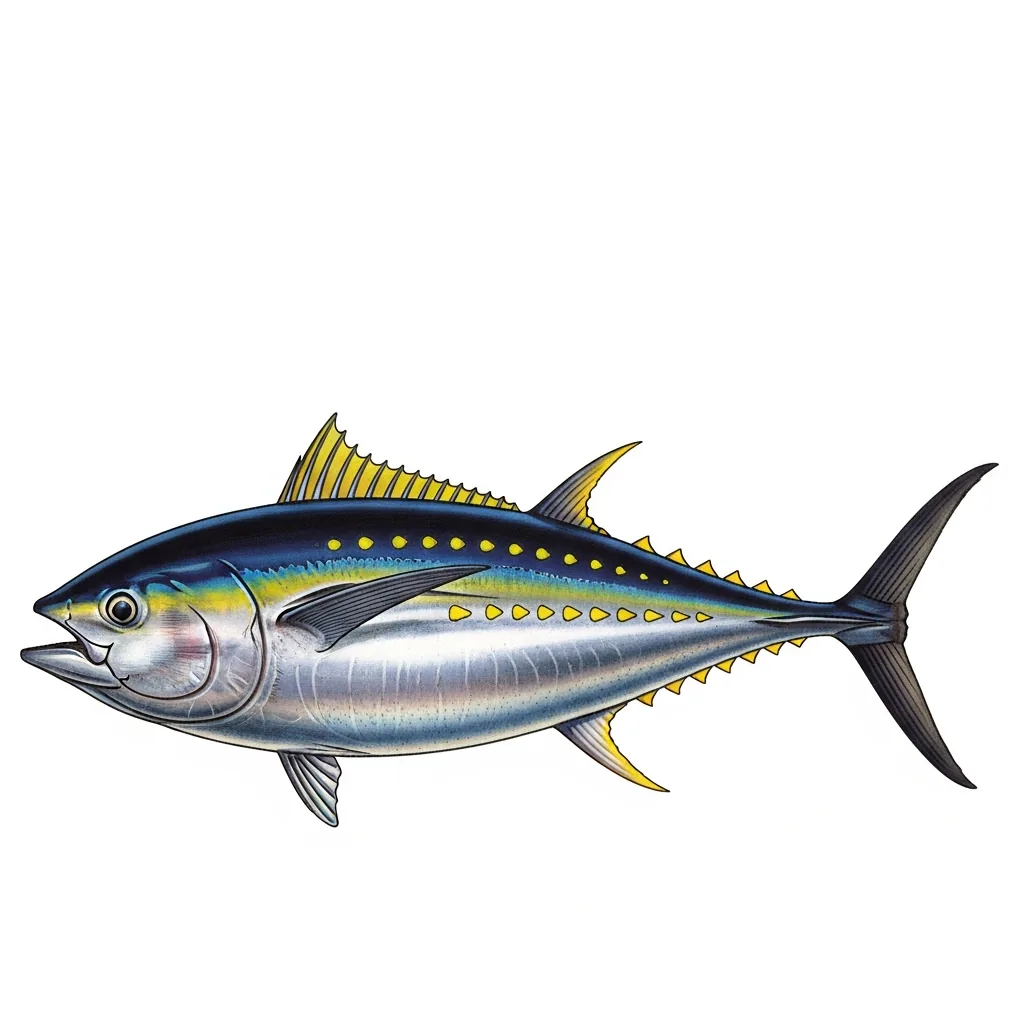
Large tuna, one of the most powerful predators in the Mediterranean.
Identification
- Body
- Streamlined and robust body, built for speed.
- Colouration
- Dark blue on top, silver on the sides and belly.
- Sexual dimorphism
- Absent or not noticeable
- Growth
- Fast-growing, quickly reaching large sizes.
Taxonomy
- Family
- Scombridae
- Order
- Perciformes
- Class
- Actinopterygii
Related species
Habitat & distribution
- Environment
- Coast, Open sea, Pelagic
- Preferred bottom
- Open sea
- Geographic distribution
- Found in the Mediterranean, Western and Eastern Atlantic.
- Micro-habitat
- Prefers open and deep waters, often near nutrient-rich currents.
Prefers waters with strong currents, where its primary prey are abundant.
Presence by sea area
Diet
- Primary prey
- anchovies, sardines, mackerel
- Secondary prey
- mollusks, crustaceans, cephalopods
- Occasional prey
- small sharks, other pelagic fish
- Feeding behaviour
- Voracious predator, often forms large schools to surround and prey on small fish.
- Natural predators
- orca, great white shark, mako shark, human
Diet varies seasonally, following the migrations of fish schools.
Behaviour
- Activity
- diurnal
- Social behaviour
- large_schools
- Aggressiveness
- high
- Migration
- Undertakes long transoceanic migrations for breeding and feeding.
- Seasonal behaviour
- Approaches coasts to spawn during warmer months, while spends colder months offshore.
- Juveniles
- Young tend to form small groups near the surface.
- Adults
- Adults form large schools and are highly active pelagic predators.
Reproduction
- Spawning season
- May, June, July
- Spawning depth
- between 20 and 200 meters
- Eggs
- Pelagic eggs, small in size with high buoyancy
- Larval stage
- Larvae are planktonic, growing rapidly in surface waters.
- Sexual maturity
- 5-8 years
When to catch Bluefin tuna
Activity calendar
Activity by season
Best times
This species shows peak fishing activity in summer, when the productivity index (FPI) reaches its highest values.
Fishing activity decreases in autumn and winter, when conditions are less favourable.
Ideal conditions
Atmospheric pressure
More active on surface.
Regular activity mid-water.
Deeper, follows thermoclines.
Water temperature
Where to catch it
Best spots
Bottom preference
Spot type
Fishing techniques
Recommended
Other applicable
Recommended baits
Baits by pressure
How to really catch it
The Atlantic bluefin tuna is the pure face of open water: a fusiform body, dark blue back, and power built for speed and for chasing bait schools in daylight. When it enters a feeding lane or cuts across a nutrient-rich current, everything changes pace: this is a fish that demands respect, technique, and composure.
🐟 Good to know
It is a pelagic fish that undertakes long transoceanic migrations between feeding and spawning areas. During the spawning season it releases highly buoyant pelagic eggs, while the larvae remain planktonic in surface waters, where they grow quickly.
🌊 Where & when
You find it in the Mediterranean and the Atlantic, mainly over open and deep water, often where currents concentrate nutrients and forage, including near submarine canyons and pelagic barriers. It approaches coasts in the warmer months to spawn, with peak presence in June, July, and August; in colder months it tends to remain offshore.
🎣 How to really catch it
If you want to fish for it for real, heavy trolling is the most concrete approach: work offshore along active currents and edges of lively water, presenting live fish, sardines, squid, or artificials with a stout trolling rod, high-strength line, and a very strong steel or fluorocarbon leader. Large hooks, including circle hooks, help manage a violent strike and a fight marked by deep runs.
💡 The detail that makes the difference
The most defensible tip is to think first about its food: anchovies, sardines, and mackerel. If you see chaotic surface activity or bait compressed by current, do not fish blindly in empty blue water; run your bait along the edge of the bait school, where a predator hunting in groups is more likely to intercept fleeing prey.
Catch & handling tips
- Fight
- Strong and powerful, fights and makes rapid deep dives.
- Handling
- Handle carefully to avoid muscle and fin damage.
- Release
- Release quickly to reduce stress and injury.
Curiosities & culture
- Record catches
- Maximum documented size: up to about 458 cm and 684 kg (source: FishBase). IGFA All-Tackle record: 678.58 kg (1,496 lb), caught by Ken Fraser at Aulds Cove, Nova Scotia (Canada), in 1979.
- In the kitchen
- Used for sushi, sashimi, and other delicacies in many international cuisines.
- Cultural notes
- A symbol of strength, often featured in cuisine and culture, emblematic of prosperity in traditional marine arts.
- Historical notes
- Tuna fishing documented since Roman times, an important economic resource in Mediterranean coastal towns.