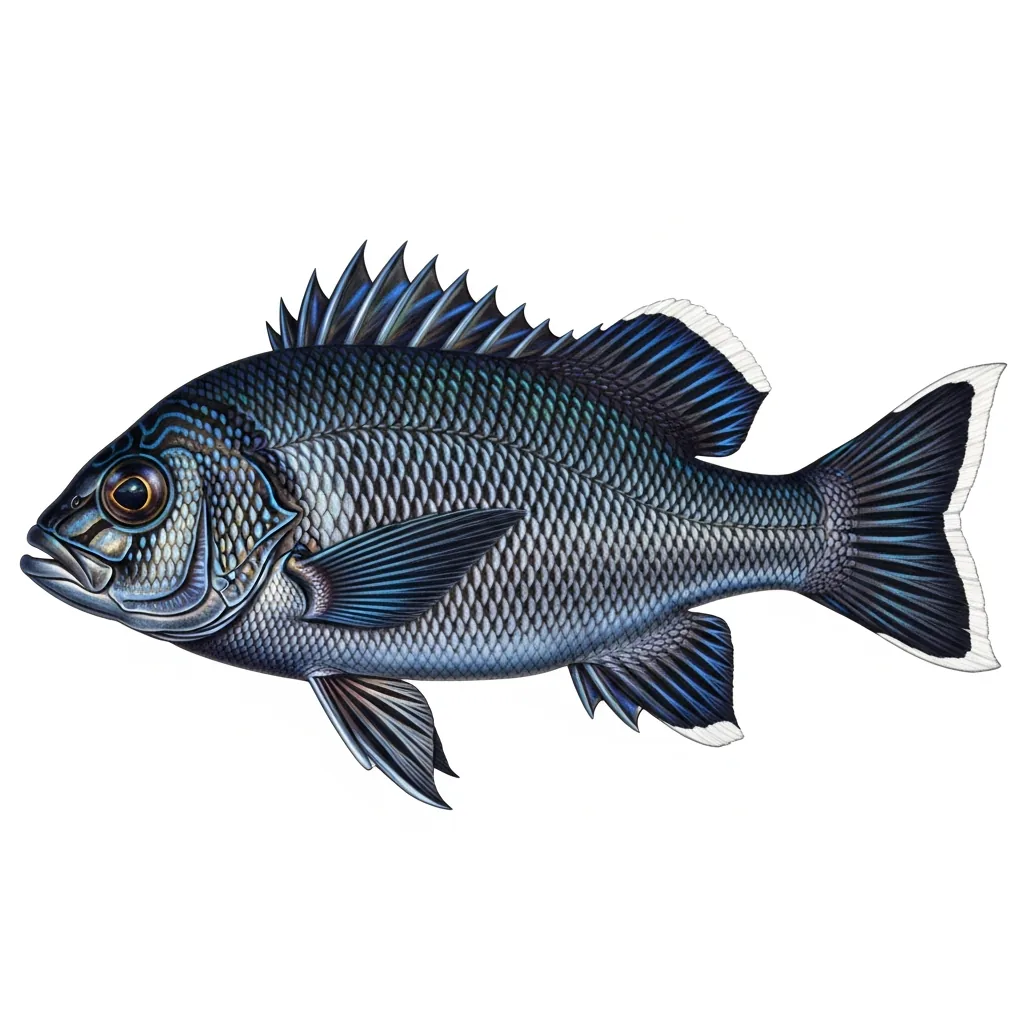

Overview
Small grouper very abundant in the US Atlantic. Easy to catch and excellent to eat.
Identification
- Body
- Compact and robust body, fusiform.
- Colouration
- Dark colors ranging from dark blue to black, with lighter spots.
- Sexual dimorphism
- Not very evident
- Growth
- medium, grows steadily throughout the year under optimal conditions
Taxonomy
- Family
- Serranidae
- Order
- Perciformes
- Class
- Actinopterygii
Related species
Habitat & distribution
- Environment
- Coast, Reefs, Brackish
- Preferred bottom
- Rock, Reef
- Geographic distribution
- Found along the eastern coast of the United States, from the Cape Cod area to northern Florida.
- Micro-habitat
- Seeks shelter among rocks and coral reefs, often near submerged wrecks.
Artificial barriers created by humans, such as wrecks, are new habitats for this species.
Presence by sea area
Diet
- Primary prey
- shrimp, crabs, small fish
- Secondary prey
- squid, mullet, octopus
- Occasional prey
- marine worms, sea urchins
- Feeding behaviour
- Opportunistic hunter, primarily feeds on the sea floor, using its camouflage ability to surprise prey.
- Natural predators
- sharks, large predatory fish, seals
Easily adapts to various food sources depending on seasonal availability.
Behaviour
- Activity
- diurnal
- Social behaviour
- small_groups
- Aggressiveness
- medium
- Migration
- residential, but may move locally to spawn or search for new food sources.
- Seasonal behaviour
- During the warmer months, it approaches the coast for spawning. In winter, it tends to retreat to deeper waters.
- Juveniles
- Young fish stay in shallow waters and hide among the seaweeds.
- Adults
- Adults form small groups and aggressively defend territory during the breeding season.
Reproduction
- Spawning season
- May, June, July
- Spawning depth
- between 20 and 60 meters
- Eggs
- Pelagic eggs, small in size, carried by currents.
- Larval stage
- The larvae are planktonic and develop in surface waters before settling to the bottom.
- Sexual maturity
- 3-4 years
When to catch Black Sea Bass
Activity calendar
Activity by season
Best times
This species shows peak fishing activity in spring, summer and autumn, when the productivity index (FPI) reaches its highest values.
Fishing activity decreases in winter, when conditions are less favourable.
Ideal conditions
Water temperature
Where to catch it
Best spots
Bottom preference
Spot type
Fishing techniques
Recommended
Other applicable
Recommended baits
Baits by pressure
How to really catch it
The black sea bass is a compact, hard-fighting grouper relative, tightly tied to the bottom and to the structure where it shelters and ambushes prey. When you target it around rocks, reefs, and wrecks, it feels like fishing right at the mouth of a den: the take is sharp, and the first move is straight down.
🐟 Good to know
One well-documented biological trait of the species is its pelagic eggs: after spawning, the eggs drift with the currents, while the larvae remain planktonic in surface waters before settling to the bottom. That life stage helps explain why adults are so closely linked to structured habitat and why juveniles use shallow, covered areas.
🌊 Where & when
It lives along the eastern coast of the United States, from Cape Cod to northern Florida, over rocky bottoms, reefs, coastal and brackish waters, often near submerged wrecks. It is most worth targeting from March to November; in the warmer months it moves closer to shore to spawn, with spawning from May to July between 20 and 60 meters, while in winter it tends to withdraw into deeper water.
🎣 How to really catch it
The most reliable way to catch it is bottom fishing over reefs, rock piles, and wrecks, letting the bait work exactly where it feeds along the seabed. A medium-action rod with 15-20 lb braided line, a 25 lb fluorocarbon leader, #1-2 circle hooks, and a 1-2 oz sinker lets you present live shrimp, squid, marine worms, or fish strips precisely beside the structure, ready to stop it when it dives straight back for cover.
💡 The detail that makes the difference
The most defensible practical tip is simple: fish the side closest to cover, not well away from it. Black sea bass is an opportunistic bottom hunter that uses camouflage and shelter among rocks and wrecks; because of that, a presentation too far off the structure often loses realism, while a bait placed in its exit lane truly enters its feeding zone.
Catch & handling tips
- Fight
- Fighting and intense, often heads towards the bottom to seek refuge.
- Handling
- Use a glove to protect your hands from the rough scales and spines of the fins.
- Release
- Ensure the fish is well-oxygenated before release, preferably by allowing water to flow slowly through the gills.
Curiosities & culture
- Record catches
- Maximum documented size: up to about 66 cm and 4.3 kg (source: FishBase). IGFA All-Tackle record: 4.65 kg, caught at Virginia Beach, Virginia (USA), in 2000.
- In the kitchen
- White and delicate meat, used in dishes such as grilling, frying, and stews. Often served baked with herbs.
- Cultural notes
- Featured in many tales of sport fishermen along the eastern coast of the United States, symbolizing abundance and good luck at sea.
- Historical notes
- Traditionally fished by Native Americans, the black sea bass has long been a food source and a symbol of prosperity.