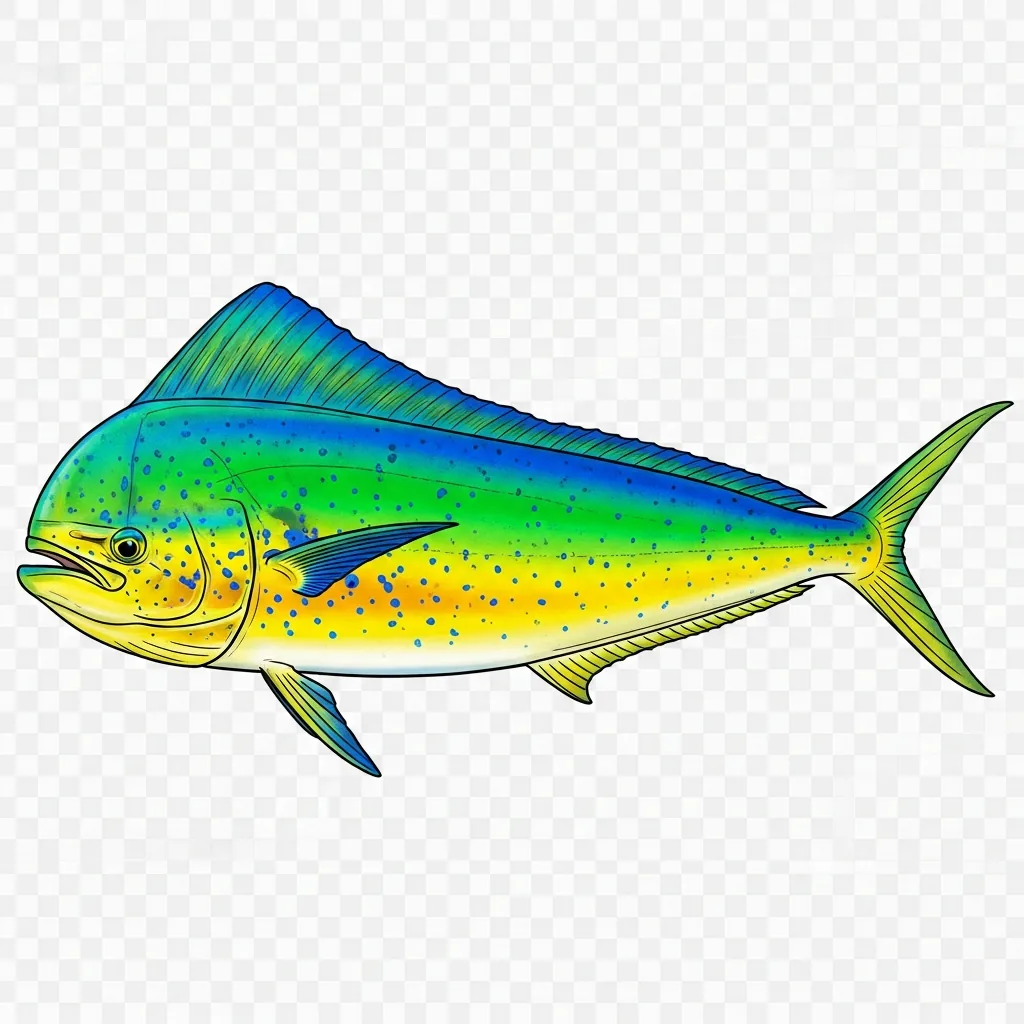

Overview
Very fast pelagic predator, often under floating objects and FADs.
Identification
- Body
- Elongated body and laterally compressed with a prominent head and high forehead.
- Colouration
- Bright green with yellow and blue hues, featuring iridescent spots.
- Sexual dimorphism
- Males have a more prominent forehead than females.
- Growth
- Fast, can reach adult size in a matter of months
Taxonomy
- Family
- Coryphaenidae
- Order
- Perciformes
- Class
- Actinopterygii
Related species
Habitat & distribution
- Environment
- Open sea, Pelagic
- Geographic distribution
- Found in all tropical and subtropical seas worldwide, including the Mediterranean Sea, Atlantic Ocean, and Pacific Ocean.
- Micro-habitat
- Often found under floating objects or FADs (Fish Aggregating Devices).
Prefer open waters and often found associated with FADs for shelter and feeding reasons.
Presence by sea area
Diet
- Primary prey
- flying fish, squid, small pelagic fish
- Secondary prey
- crustaceans, jellyfish, salps
- Occasional prey
- octopus, plankton, cephalopods
- Feeding behaviour
- Opportunistic predator that uses speed to chase and capture preferred prey.
- Natural predators
- tunas, swordfish, sharks, humans
An efficient predator due to its speed and agility in chasing prey.
Behaviour
- Activity
- diurnal
- Social behaviour
- small_groups
- Aggressiveness
- medium
- Migration
- Migrate seasonally to warmer waters.
- Seasonal behaviour
- More active during summer months as they migrate to warm waters.
- Juveniles
- Young ones often found in small groups around floating debris.
- Adults
- Adults can form small schools when hunting.
Reproduction
- Spawning season
- May, June, July, August
- Spawning depth
- from the surface down to 30 meters
- Eggs
- Pelagic eggs, small in size, hatch quickly.
- Larval stage
- Larvae are planktonic and grow rapidly by feeding on zooplankton.
- Sexual maturity
- varies between 1 and 2 years
When to catch Mahi-mahi / Dolphinfish
Activity calendar
Activity by season
Best times
This species shows peak fishing activity in summer, when the productivity index (FPI) reaches its highest values.
Fishing activity decreases in autumn and winter, when conditions are less favourable.
Ideal conditions
Atmospheric pressure
Very active on surface.
Good activity, follows floating objects.
Deeper but still active.
Water temperature
Where to catch it
Best spots
Bottom preference
Spot type
Fishing techniques
Recommended
Other applicable
Recommended baits
Baits by pressure
How to really catch it
The dolphinfish is a pelagic predator that seems made of water and light: a long body, high forehead, iridescent colors, and a crescent tail built for speed in the blue. When it starts hunting near a floating object or along a lively water seam, its presence changes the sea and forces the angler to read every detail.
🐟 Good to know
An important biological trait, often overlooked, is that dolphinfish reach maturity very early, generally between 1 and 2 years. Their eggs are pelagic and spawning takes place from the surface down to 30 meters, with planktonic larvae that grow quickly by feeding on zooplankton.
🌊 Where & when
You find it offshore, from the surface to about 85 meters, in tropical and subtropical waters worldwide, including the Mediterranean. It becomes most appealing in summer, especially from June to August, when it migrates toward warmer water; at that time it often holds around FADs, floating debris, oceanic islands, and upwelling areas.
🎣 How to really catch it
To target it effectively, trolling is the most concrete approach: work offshore near FADs or under floating debris, trolling squid, spoons, or soft plastics that mimic small pelagic fish and fast prey. Spinning and live baiting with small live fish also work, using a sturdy offshore rod, 20-30 lb braid, and a 40-60 lb nylon or fluorocarbon leader.
💡 The detail that makes the difference
The practical edge is simple: do not pass too far from anything floating. Dolphinfish, especially juveniles but not only them, often gather beneath surface cover. When you find an object at sea, do not make just one quick pass; work around the edge of the shade and the trailing water, where small fish and squid become natural targets.
Catch & handling tips
- Fight
- Strong fighter, leaps out of the water and performs multiple acrobatics.
- Handling
- Avoid caudal and dorsal fins as they can be sharp.
- Release
- Handle carefully and release quickly to minimize stress.
Curiosities & culture
- Record catches
- Maximum documented size: up to about 210 cm and 40 kg (source: FishBase). IGFA All-Tackle record: 39.46 kg (87 lb), caught in the Gulf of Papagayo (Costa Rica) in 1976.
- In the kitchen
- Used for grilled fish, seasoned with citrus and spices, often served in tropical restaurants.
- Cultural notes
- Considered a symbol of speed and strength in tropical seas.
- Historical notes
- Recognized by pirates and sailors for its beauty and culinary delight.