
Overview
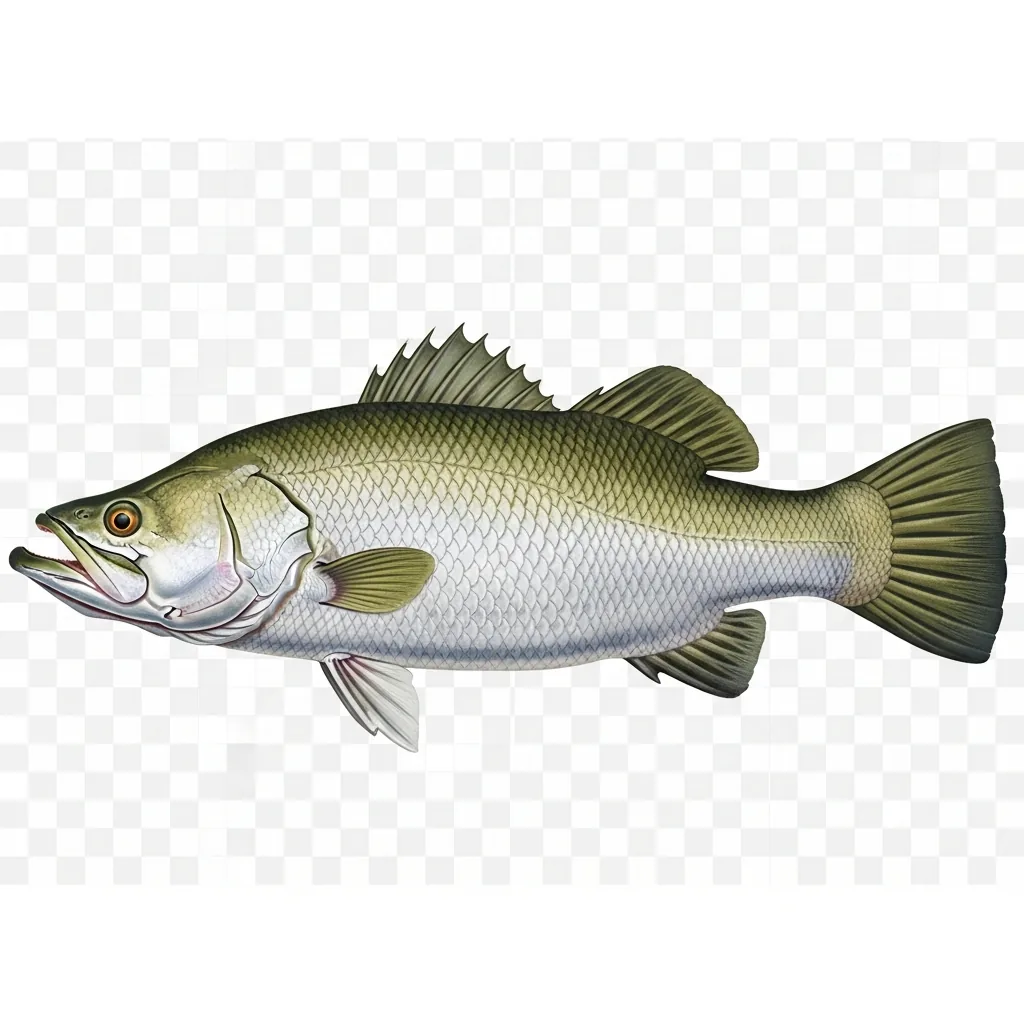
Iconic fish of Australia and Southeast Asia, exceptional fighter.
Identification
- Body
- Robust and elongated body with an arched dorsal profile.
- Colouration
- Silver color with greenish or brownish reflections, darker on the back.
- Sexual dimorphism
- Not very evident
- Growth
- Rapid, especially in the early years of life.
Taxonomy
- Family
- Latidae
- Order
- Perciformes
- Class
- Actinopterygii
Related species
Habitat & distribution
- Environment
- Coast, Estuaries, Brackish
- Preferred bottom
- Sand, Mud, Seagrass, Estuaries
- Geographic distribution
- Found in the coastal waters of Southeast Asia and northern Australia.
- Micro-habitat
- Often shelters among the roots of mangroves and weeds in shallow waters.
Prefers sandy and muddy bottoms with vegetation; tolerates wide salinity variations.
Presence by sea area
Diet
- Primary prey
- fish, crustaceans, aquatic insects
- Secondary prey
- mollusks, octopuses, shrimp
- Occasional prey
- frogs, water snakes
- Feeding behaviour
- Ambush predator that chases its prey with quick bursts of speed.
- Natural predators
- crocodiles, sharks, sea snakes, sea eagles
Hunts in shallow waters taking advantage of poor visibility to surprise prey.
Behaviour
- Activity
- diurnal
- Social behaviour
- solitary
- Aggressiveness
- medium
- Migration
- Migratory for spawning in brackish waters.
- Seasonal behaviour
- Often moves to freshwater areas during the dry season.
- Juveniles
- Juveniles tend to stay closer to the coast and in estuaries.
- Adults
- Adults are more mobile and can move between fresh and saltwater.
Reproduction
- Spawning season
- November, December, January
- Spawning depth
- between 5 and 10 meters
- Eggs
- Pelagic eggs, small and numerous.
- Larval stage
- They develop in brackish water, going through several stages before becoming juveniles.
- Sexual maturity
- 3-4 years
When to catch Barramundi
Activity calendar
Activity by season
Best times
This species shows peak fishing activity in spring, summer and autumn, when the productivity index (FPI) reaches its highest values.
Fishing activity decreases in winter, when conditions are less favourable.
Ideal conditions
Atmospheric pressure
Very aggressive and active.
Good hunting activity.
Less reactive.
Water temperature
Where to catch it
Best spots
Bottom preference
Spot type
Fishing techniques
Recommended
Other applicable
Recommended baits
Baits by pressure
How to really catch it
Barramundi is a powerful predator of tropical coastal waters, a robust fish that alternates stillness with violent bursts. When it moves through mangroves, estuaries, and river mouths, every cast can turn into a sharp strike and a run full of jumps.
🐟 Good to know
One well-documented biological trait of barramundi is that its eggs are pelagic: they are released into the water column and remain suspended, while the larvae develop in brackish water before becoming juveniles. It is a strategy that tightly links the species to estuaries and transition waters.
🌊 Where & when
You find it in the coastal waters of Southeast Asia and northern Australia, especially in estuaries, coastal lagoons, river mouths, and shallow areas over sand, mud, and seagrass. It often stays close to mangrove roots and vegetation in shallow water. The most favorable months run from March to November; during the dry season it often shifts toward freshwater areas, while from November to January it migrates to brackish water to spawn.
🎣 How to really catch it
To catch it for real, spinning is the most concrete approach: a medium-heavy spinning rod, 20-30 lb braid, and a 40 lb fluorocarbon leader give you control near cover. Work artificial lures or shrimp along mangroves, estuary mouths, and weed edges with retrieves that mix movement and pauses. Barramundi is an ambush predator: it often launches from a standstill, strikes close to cover, then responds with hard bursts and jumps out of the water.
💡 The detail that makes the difference
The most reliable tip is to run the bait as close to shelter as possible without ruining the presentation: roots, weeds, channel edges, small bottom breaks. Its wide, protrusible mouth is suited to sucking in prey such as fish and crustaceans, so a precise, short, controlled presentation often matters more than a fast retrieve far from structure.
Catch & handling tips
- Fight
- Reacts with energetic bursts and jumps out of the water.
- Handling
- Use a glove to protect your hand from dorsal spines.
- Release
- Support the fish in the water until it regains strength.
Curiosities & culture
- Record catches
- Maximum documented size: up to about 2 m in length and over 50 kg (source: FishBase). IGFA All-Tackle record: 44.64 kg (98 lb 7 oz), caught by Denis Harrold at Lake Monduran, Queensland (Australia), on 12 December 2010.
- In the kitchen
- Excellent white flesh, used for grilling and baking dishes.
- Cultural notes
- Considered an iconic fish among Australian sport fishers.
- Historical notes
- Traditionally caught by Indigenous Australians for its abundance and flavor.