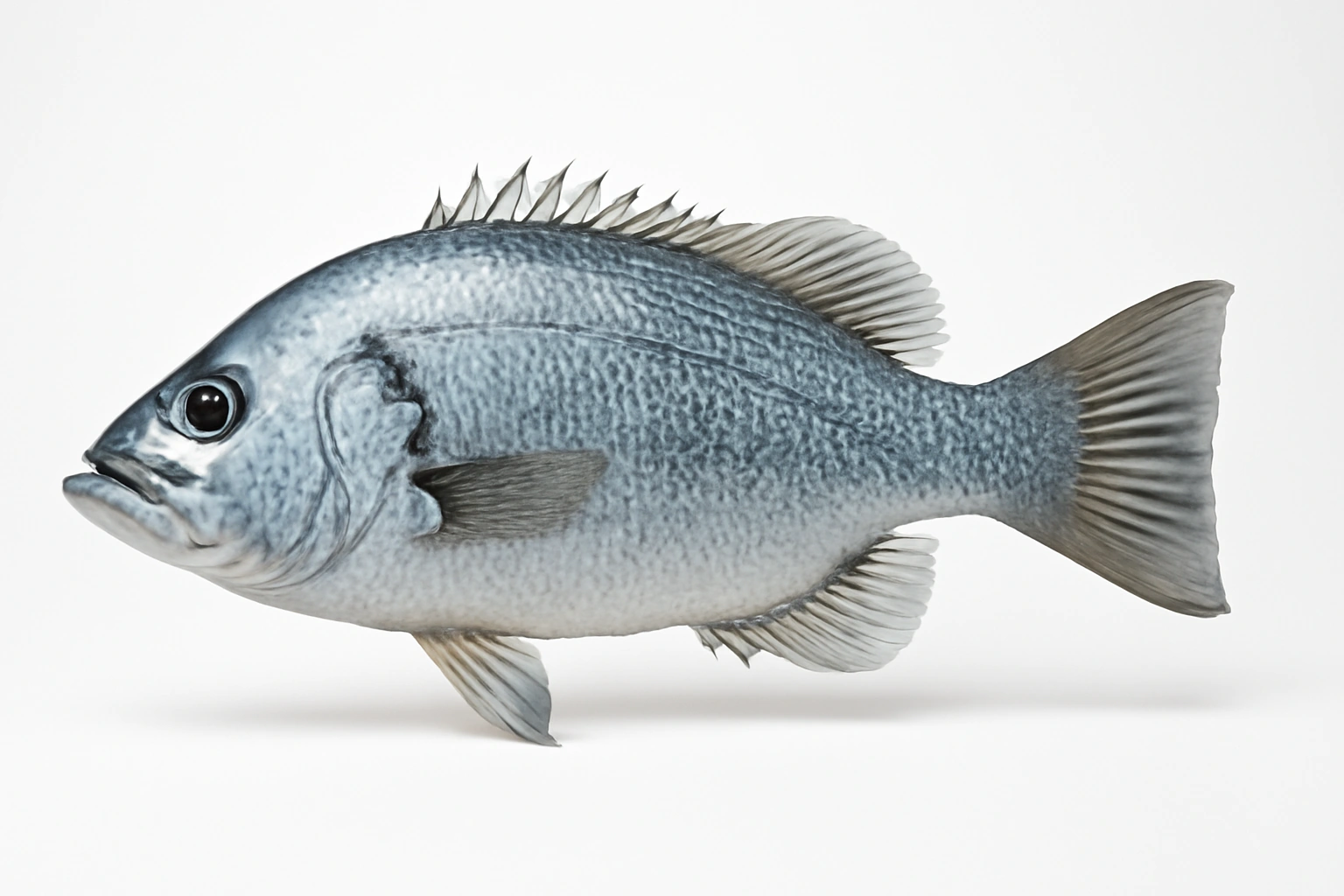

Overview
The Dhufish is endemic to Western Australia and is considered the state's iconic fish. With its sweet white flesh, it's arguably Australia's finest eating fish. Found only on limestone reefs off the west coast.
Identification
- Body
- The body is sturdy and elongated with a broad head.
- Colouration
- Silvery coloration with dark bands running across the body.
- Sexual dimorphism
- Not very pronounced
- Growth
- Moderate, reaches maturity in a few years
Taxonomy
- Family
- Glaucosomatidae
- Order
- Perciformes
- Class
- Actinopterygii
Related species
Habitat & distribution
- Environment
- Reefs, Open sea
- Preferred bottom
- Reef
- Geographic distribution
- Endemic to Western Australia, from north of Shark Bay to Cape Naturaliste.
- Micro-habitat
- Hides among reef crevices and feeds off rocky formations.
Prefers rocky reefs where it can effectively hide from predators.
Presence by sea area
Diet
- Primary prey
- fish, squid, prawns
- Secondary prey
- amphipods, isopods, cephalopods
- Occasional prey
- corals, sponges
- Feeding behaviour
- Primarily feeds at night, hunting its prey among rock and reef hideouts.
- Natural predators
- grey reef shark, rays, kingfish
Primarily hunts on the seabed during nighttime.
Behaviour
- Activity
- nocturnal
- Social behaviour
- solitary
- Aggressiveness
- medium
- Migration
- Non-migratory, with limited movements between reefs
- Seasonal behaviour
- Active year-round but more aggressive in feeding during summer months.
- Juveniles
- Young fish stay close to the shore before moving to deeper waters.
- Adults
- Adults are solitary and prefer deeper waters.
Reproduction
- Spawning season
- January, February
- Spawning depth
- between 20 and 60 meters
- Eggs
- Pelagic eggs, small and buoyant
- Larval stage
- Larvae develop rapidly and move to deeper waters as they grow.
- Sexual maturity
- 3-4 years
When to catch Dhufish
Activity calendar
Activity by season
Best times
This species shows peak fishing activity in spring, summer and autumn, when the productivity index (FPI) reaches its highest values.
Fishing activity decreases in winter, when conditions are less favourable.
Ideal conditions
Water temperature
Where to catch it
Best spots
Bottom preference
Spot type
Fishing techniques
Recommended
Other applicable
Recommended baits
Baits by pressure
How to really catch it
Dhufish is a powerful, secretive reef fish, with a broad head, large eyes, and the habit of vanishing into crevices the moment it feels pressure. To catch it for real, you have to picture the bottom before you ever see it: stone, darkness, depth, and a strike that often starts close to cover.
🐟 Good to know
An important biological trait of dhufish is that it produces small, buoyant pelagic eggs. After hatching, the larvae develop quickly and move progressively into deeper water as they grow, while juveniles first remain closer to shore before following the same path.
🌊 Where & when
It is endemic to Western Australia, from north of Shark Bay to Cape Naturaliste, and lives on reefs, rocky shoals, pinnacles, and limestone formations from 20 to 200 meters. Adults are solitary, resident fish more typical of deeper water; it stays active year-round, but feeds more aggressively in summer, while from March to November it remains especially worthwhile to target.
🎣 How to really catch it
The most concrete approach is deep dropping over deep reef: a powerful deep-water rod, 20-30 kg line, 50 lb fluorocarbon leader, 6/0-8/0 circle hooks, and 150-300 g teardrop sinkers to keep the bait pinned close to rock. Squid, sardines, prawns, and other cephalopods match its diet well; the bite often comes around cover, and then the fish immediately tries to drive back down.
💡 The detail that makes the difference
The most defensible tip is to work the edge of the hideout, not the deepest part of the lair. Dhufish shelters in reef cracks but hunts among rocky cover and just off the formations, so presenting the bait tight to the reef without letting it wedge into the structure gives you a better chance of meeting a feeding fish rather than one locked inside its refuge.
Catch & handling tips
- Fight
- Fights hard, tends to dive towards the bottom.
- Handling
- Handle carefully to avoid injury from dorsal spines.
- Release
- Avoid damaging the swim bladder, release promptly.
Curiosities & culture
- Record catches
- Maximum documented size: up to about 122 cm and 26 kg (source: FishBase). There is no IGFA All-Tackle record for this species.
- In the kitchen
- Highly valued meat, used in baked and grilled dishes.
- Cultural notes
- Regarded as a symbol of Western Australia.
- Historical notes
- Traditionally fished by coastal Australian communities for its commercial value.