
Overview
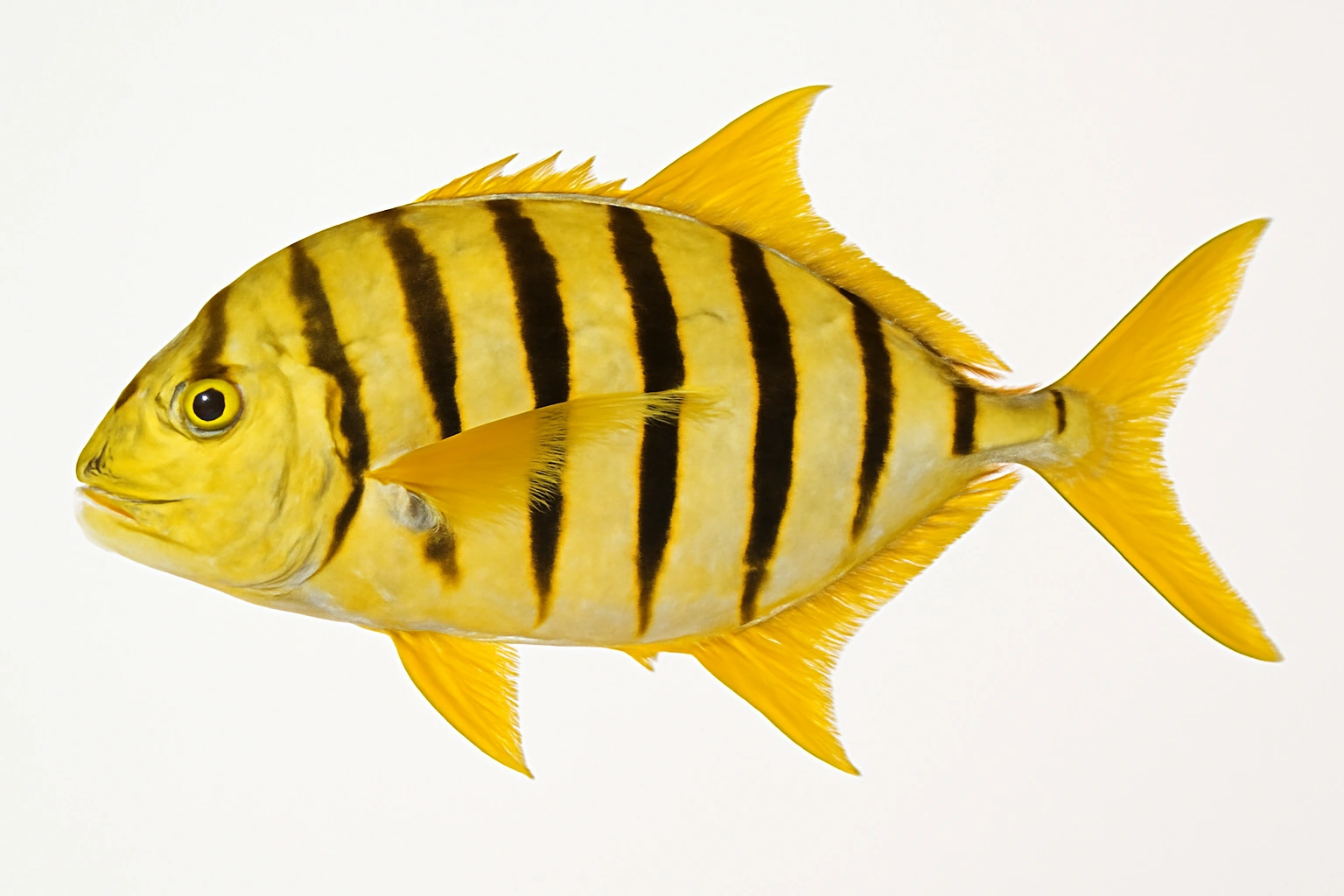
The Golden Trevally is a spectacular fish with golden colouring and black vertical bars. Very powerful for its size, offers explosive fights. Found in tropical and subtropical Australian waters, often near coral reefs.
Identification
- Body
- Elongated and laterally compressed body with an oval profile.
- Colouration
- Bright golden color with vertical black bands.
- Sexual dimorphism
- Absent/not obvious
- Growth
- Medium, with faster growth in juvenile stages.
Taxonomy
- Family
- Carangidae
- Order
- Perciformes
- Class
- Actinopterygii
Related species
Habitat & distribution
- Environment
- Coast, Open sea, Reefs
- Preferred bottom
- Reef, Sand
- Geographic distribution
- Common in the tropical and subtropical waters of the Indo-Pacific, including Australia's coastal region.
- Micro-habitat
- Often found near coral reefs, where it can hide among the corals and sand.
Abundant in regions with mixed sand and reef bottoms.
Presence by sea area
Diet
- Primary prey
- small fish, crustaceans, squid
- Secondary prey
- shrimps, small mollusks, fish larvae
- Occasional prey
- jellyfish, annelids
- Feeding behaviour
- Actively hunts in schools, using speed to surprise prey.
- Natural predators
- sharks, dolphins, tuna
They adapt their diet based on availability, increasing competitiveness.
Behaviour
- Activity
- diurnal
- Social behaviour
- small_groups
- Aggressiveness
- medium
- Migration
- Resident, with limited movements for feeding and reproduction.
- Seasonal behaviour
- Shows more activity during periods of high prey availability.
- Juveniles
- Juveniles are often closer to shore, using shallow waters for protection.
- Adults
- Adults form small groups and can be seen hunting collaboratively.
Reproduction
- Spawning season
- November, December, January
- Spawning depth
- Between 20 and 60 meters
- Eggs
- Small, clear, and floating pelagic eggs.
- Larval stage
- Transparent larvae with rapid fin growth in the first month.
- Sexual maturity
- 3-4 years
When to catch Golden Trevally
Activity calendar
Activity by season
Best times
This species shows peak fishing activity in spring, summer and autumn, when the productivity index (FPI) reaches its highest values.
Fishing activity decreases in winter, when conditions are less favourable.
Ideal conditions
Water temperature
Where to catch it
Best spots
Bottom preference
Spot type
Fishing techniques
Recommended
Other applicable
Recommended baits
Baits by pressure
How to really catch it
The golden trevally is a coastal pelagic that blends elegance with raw intent: a laterally compressed body, forked tail, and flanks flashing gold beside reef and sand. When it moves in small groups and tightens the circle on prey, you immediately understand why it is such a compelling sportfish.
🐟 Good to know
As juveniles, they show clear dark vertical bars along the flanks and are more often found in shallow inshore water, where they gain protection. As they grow, they remain tied to coastal and reef habitats, but adults are more often seen in small groups actively hunting.
🌊 Where & when
Look for it across the tropical and subtropical Indo-Pacific, along coasts, reefs, lagoons, and open-water areas linked to coral structures, from the surface down to 100 meters. It becomes more worth targeting during periods of high prey availability, with a favorable window from March to November; from November to January it also enters the spawning season, with spawning between 20 and 60 meters.
🎣 How to really catch it
If you want to catch it for real, spinning is the most concrete approach: work artificial lures or a natural bait such as squid, shrimp, or live fish around coral reefs, tidal entrances, and current zones, where small groups patrol and burst forward. A medium-heavy spinning rod with 30 lb braid and a 40 lb fluorocarbon leader gives you control during the hard runs and quick direction changes right after the strike.
💡 The detail that makes the difference
The most useful trick is to read the water before choosing the presentation: golden trevally hunt in groups and use current, sand edges, and reef cover to ambush small fish, crustaceans, and squid. That is why it pays to run the bait or lure along the boundary between structure and open bottom, through the fish’s natural feeding lane rather than directly over coral.
Catch & handling tips
- Fight
- Feisty, with strong runs and quick changes of direction once hooked.
- Handling
- Wear gloves to avoid injuries from sharp fins and support the body to reduce stress.
- Release
- Ensure the fish is well oxygenated before releasing.
Curiosities & culture
- Record catches
- Maximum documented size: up to about 120 cm and 15 kg (source: FishBase). There is no official global IGFA All-Tackle record; the largest documented catches are around 13 kg (Australia).
- In the kitchen
- Consumed very fresh, often grilled or fried. Popular in Southeast Asian cuisine.
- Cultural notes
- Often depicted in maritime art for its beauty and unique color.
- Historical notes
- Traditionally fished by coastal communities for its nutritional and commercial value.