
Overview
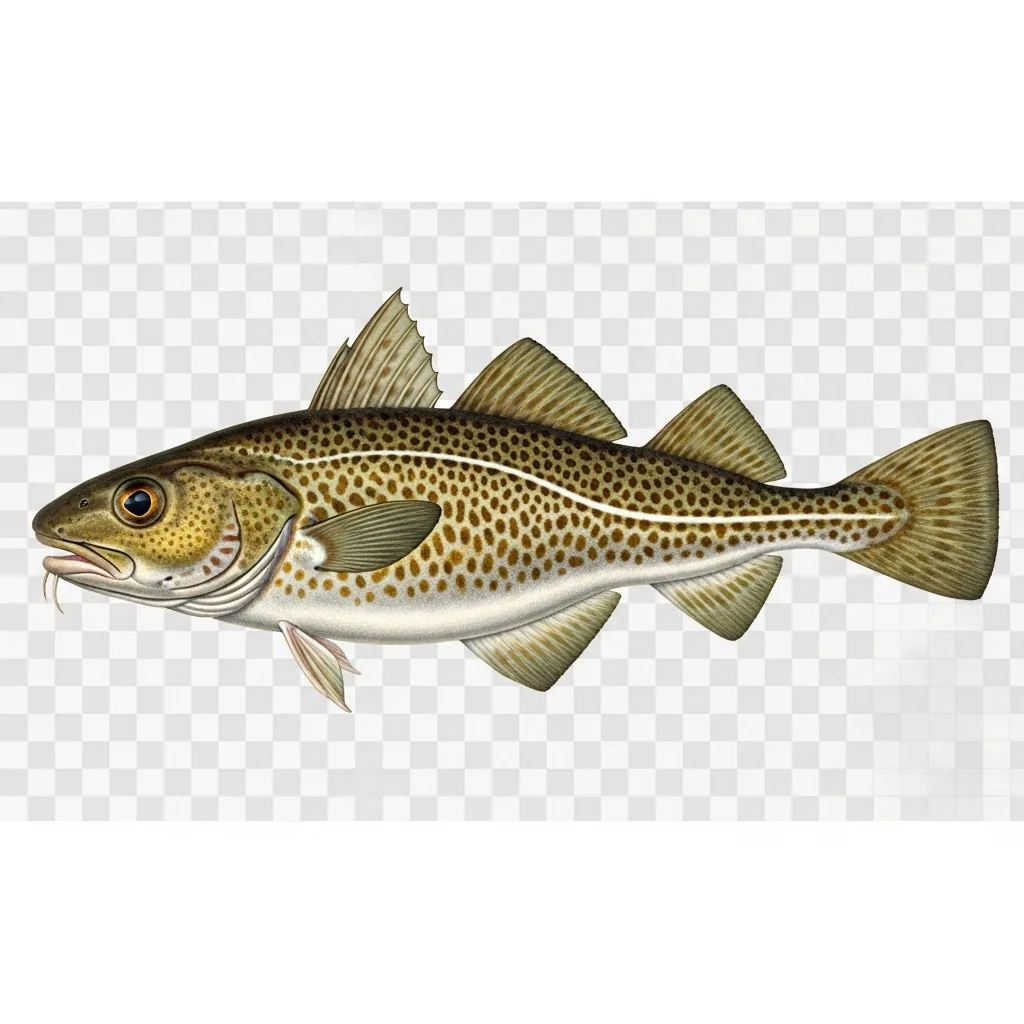
Large demersal fish of cold North Atlantic waters, highly sought after.
Identification
- Body
- Elongated body with a large head and wide mouth.
- Colouration
- Brownish-green back, lighter sides, and a whitish belly.
- Sexual dimorphism
- Not very pronounced
- Growth
- Fast, especially in the early years of life.
Taxonomy
- Family
- Gadidae
- Order
- Gadiformes
- Class
- Actinopterygii
Related species
Habitat & distribution
- Environment
- Coast, Open sea, Deep sea
- Preferred bottom
- Sand, Rock, Mud, Gravel
- Geographic distribution
- Found in the northern Atlantic, from the Barents Sea to the Gulf of Maine.
- Micro-habitat
- Lives near the seabed, occasionally in schools, foraging.
Prefers bottoms with an abundance of natural shelter.
Presence by sea area
Diet
- Primary prey
- crustaceans, lanchetes, capelin
- Secondary prey
- herring, cuttlefish, squid, gobies
- Occasional prey
- jellyfish, fish scraps, fish larvae
- Feeding behaviour
- Hunts mainly at night, an opportunistic predator, also feeds on smaller fish.
- Natural predators
- seals, Greenland shark, whales, humans
Extremely versatile in feeding methods, increasing its success.
Behaviour
- Activity
- nocturnal
- Social behaviour
- small_groups
- Aggressiveness
- medium
- Migration
- Undergoes seasonal migrations for spawning and feeding.
- Seasonal behaviour
- In winter months, it moves closer to the coast for spawning.
- Juveniles
- Young fish form schools for protection.
- Adults
- Adults can be solitary or in small groups, often near the bottom.
Reproduction
- Spawning season
- January, February, March
- Spawning depth
- between 20 and 300 meters
- Eggs
- Pelagic and transparent eggs, about 1.5 mm in diameter.
- Larval stage
- Larvae are planktonic and quickly transform into young fish that move to shallower waters.
- Sexual maturity
- 3-4 years
When to catch Atlantic cod
Activity calendar
Activity by season
Best times
This species shows peak fishing activity in spring, summer and autumn, when the productivity index (FPI) reaches its highest values.
Fishing activity decreases in winter, when conditions are less favourable.
Ideal conditions
Atmospheric pressure
Very active, rises towards surface.
Normal activity along the bottom.
Less mobile, stays near the bottom.
Water temperature
Where to catch it
Best spots
Bottom preference
Spot type
Fishing techniques
Recommended
Other applicable
Recommended baits
Baits by pressure
How to really catch it
Atlantic cod is a large bottom predator, as plain and purposeful as the cold sea it inhabits. When you truly fish for it, you are not chasing a surface flash: you picture a shape patrolling the seabed, close to sand, rock, and mud, ready to take an easy but substantial meal.
🐟 Good to know
One subtle but useful detail for anglers is the chin barbel: it is a sensory organ that helps cod search for food close to the bottom. It is not decoration; it reflects a life spent reading the seabed, especially where visibility matters less than contact with the substrate.
🌊 Where & when
It lives across the northern Atlantic, from the Barents Sea to the Gulf of Maine, from the coast to offshore waters, over sand, rock, mud, and gravel, from shallow water to great depth. It stays near the seabed, sometimes in small groups, and becomes more approachable through the productive season from March to November; in winter it moves closer to the coast to spawn, between 20 and 300 meters.
🎣 How to really catch it
To truly catch it, the most practical route is a handline or a medium-heavy bottom-fishing rod worked straight down over banks, submerged reefs, mixed sand-and-mud bottoms, and rocky coasts. Braided line of 0.35-0.50, a 0.40 fluorocarbon leader, strong 1/0-3/0 hooks, and a 150-300 gram sinker help keep the rig pinned to the bottom; herring, squid, cuttlefish, and shrimp all match its opportunistic diet.
💡 The detail that makes the difference
The tip that really matters is simple: stay within a few meters of the bottom and do not rush to lift the bait too high. Cod forages close to the substrate and hunts mainly at night; when the bait remains in its natural lane, over mixed ground or along the edge of rock, it passes right through the zone where cod looks for fish, cephalopods, and crustaceans.
Catch & handling tips
- Fight
- Struggles vigorously when hooked, especially in the early stages.
- Handling
- Handle carefully to avoid injuries, support well under the belly.
- Release
- Return immediately to the water, avoiding prolonged exposure to air.
Curiosities & culture
- Record catches
- Maximum documented size: up to about 200 cm and 96 kg (source: FishBase). IGFA All-Tackle record: 47.03 kg (103 lb 1 oz), caught by Michael Eisele at Sørøya (Norway) in 2013.
- In the kitchen
- Mainly used salted as bacalao, a key ingredient in dishes like baccalà alla vicentina.
- Cultural notes
- Iconic in Nordic culture, featured in many ancient stories and myths.
- Historical notes
- Historically important to the economies of coastal communities in Northern Europe. Played a key role in fishing rights disputes.