
Overview
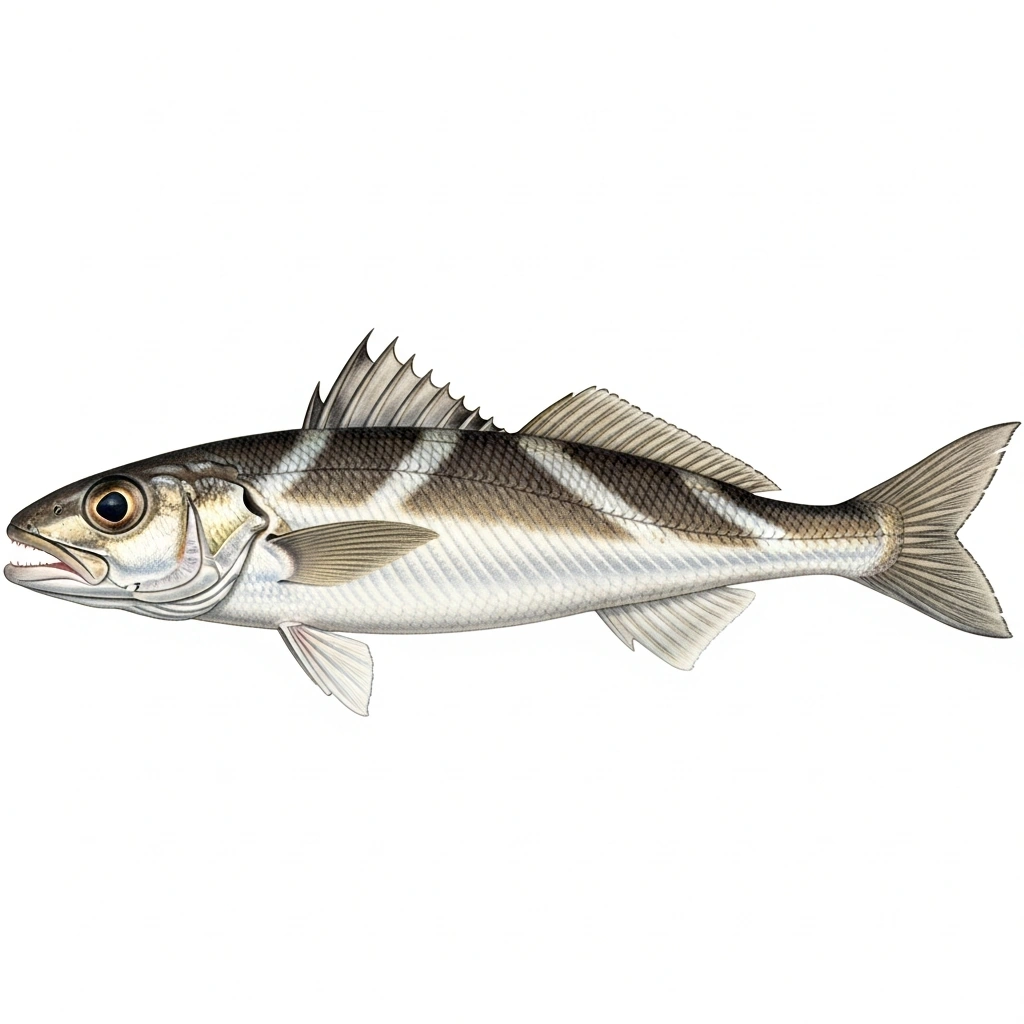
The most caught fish in the South American Atlantic. Present in huge schools from Argentina to southern Brazil.
Identification
- Body
- The body is elongated with a slightly arched dorsal profile.
- Colouration
- The body color ranges from silvery gray to golden, with a white belly.
- Sexual dimorphism
- absent/not prominent
- Growth
- fast in nutrient-rich environments
Taxonomy
- Family
- Sciaenidae
- Order
- Perciformes
- Class
- Actinopterygii
Related species
Habitat & distribution
- Environment
- Estuaries, Coast, Brackish
- Preferred bottom
- Sand, Mud, Estuarine
- Geographic distribution
- Found along the Atlantic coast of South America, from Argentina to southern Brazil.
- Micro-habitat
- Often hides in sandy or muddy bottoms of estuarine areas.
Estuaries provide a nutrient-rich and sheltered environment.
Presence by sea area
Diet
- Primary prey
- small fish, shrimp, crustaceans
- Secondary prey
- mollusks, annelids, insect larvae
- Occasional prey
- plankton, algae
- Feeding behaviour
- Feeds primarily on the bottom, using its prominent lower mouth to sift through sediment for prey.
- Natural predators
- sharks, tunas, dolphins
Plays an important role in controlling small crustacean populations.
Behaviour
- Activity
- diurnal
- Social behaviour
- large_schools
- Aggressiveness
- low
- Migration
- Undergoes seasonal migrations to warmer areas for spawning.
- Seasonal behaviour
- Approaches coasts in spring and summer for reproduction.
- Juveniles
- Juveniles are often found in shallower, sheltered estuarine waters.
- Adults
- Adults form large schools and move between estuaries and coastal waters.
Reproduction
- Spawning season
- November, December, January
- Spawning depth
- between 10 and 30 meters
- Eggs
- pelagic eggs, small and transparent
- Larval stage
- Larvae are pelagic, floating near the surface until metamorphosis.
- Sexual maturity
- 2-4 years
When to catch Whitemouth croaker
Activity calendar
Activity by season
Best times
This species shows peak fishing activity in spring, summer and autumn, when the productivity index (FPI) reaches its highest values.
Fishing activity decreases in winter, when conditions are less favourable.
Ideal conditions
Atmospheric pressure
Very active, feeds voraciously.
Constant activity, responds to various baits.
Less active but present.
Water temperature
Where to catch it
Best spots
Bottom preference
Spot type
Fishing techniques
Recommended
Other applicable
Recommended baits
Baits by pressure
How to really catch it
The Southern croaker is a bottom fish that lives where the water changes color and smell: estuaries, river mouths, dark sand stirred by the tide. It lacks the violence of major predators, but when a school settles to feed on the bottom, its bite becomes a subtle and very real kind of fishing.
🐟 Good to know
A key part of its biology is its prominent lower mouth: not just a visual trait, but the adaptation it uses to feed on the bottom, sifting sediment for shrimp, small crustaceans, mollusks, and annelids. That is why its presence is often revealed more by the nature of the bottom than by what the surface water looks like.
🌊 Where & when
It is found along the Atlantic coast of South America, from Argentina to southern Brazil, in estuaries, brackish waters, and low coasts with sandy or muddy bottoms, from 1 to 50 meters. Adults move in large schools between estuaries and coastal waters and become more reachable in spring and summer, when they approach shore to spawn; the most productive stretch runs from March to November.
🎣 How to really catch it
To really catch it, think low and slow. The most concrete setup is a medium spinning rod with 10-20 lb braid, a 15 lb fluorocarbon leader, a #2/0 circle hook, and an olive sinker, presenting shrimp, marine worms, squid strips, or small fish pieces right on the bottom in river mouths, lagoons, and sandy coasts. Southern croaker feeds by sifting sediment: the bait must stay where it searches, not suspended above it.
💡 The detail that makes the difference
The practical edge is simple: focus on bottom transitions, where sand meets mud in estuaries or at lagoon entrances. That is where a benthic, schooling fish like this more easily finds bottom prey, and if you contact one, it is often worth working that same band of water carefully because adults move in schools.
Catch & handling tips
- Fight
- The fish puts up a moderate fight, often trying to swim in circles.
- Handling
- Handle gently to avoid damaging the fins.
- Release
- Release quickly and ensure it swims away strongly.
Curiosities & culture
- Record catches
- Maximum documented size: up to about 60 cm in length (source: FishBase). There is no official IGFA All-Tackle weight record for this species.
- In the kitchen
- Its flesh is highly valued, used in dishes like mixed fry and ceviche.
- Cultural notes
- In some countries, it's considered a symbol of fertility due to its abundance.
- Historical notes
- Traditionally fished by South American coastal communities for generations.