
Overview
Very fast coastal fish highly prized both as game fish and for its meat. Feeds in the surf on beaches.
Identification
- Body
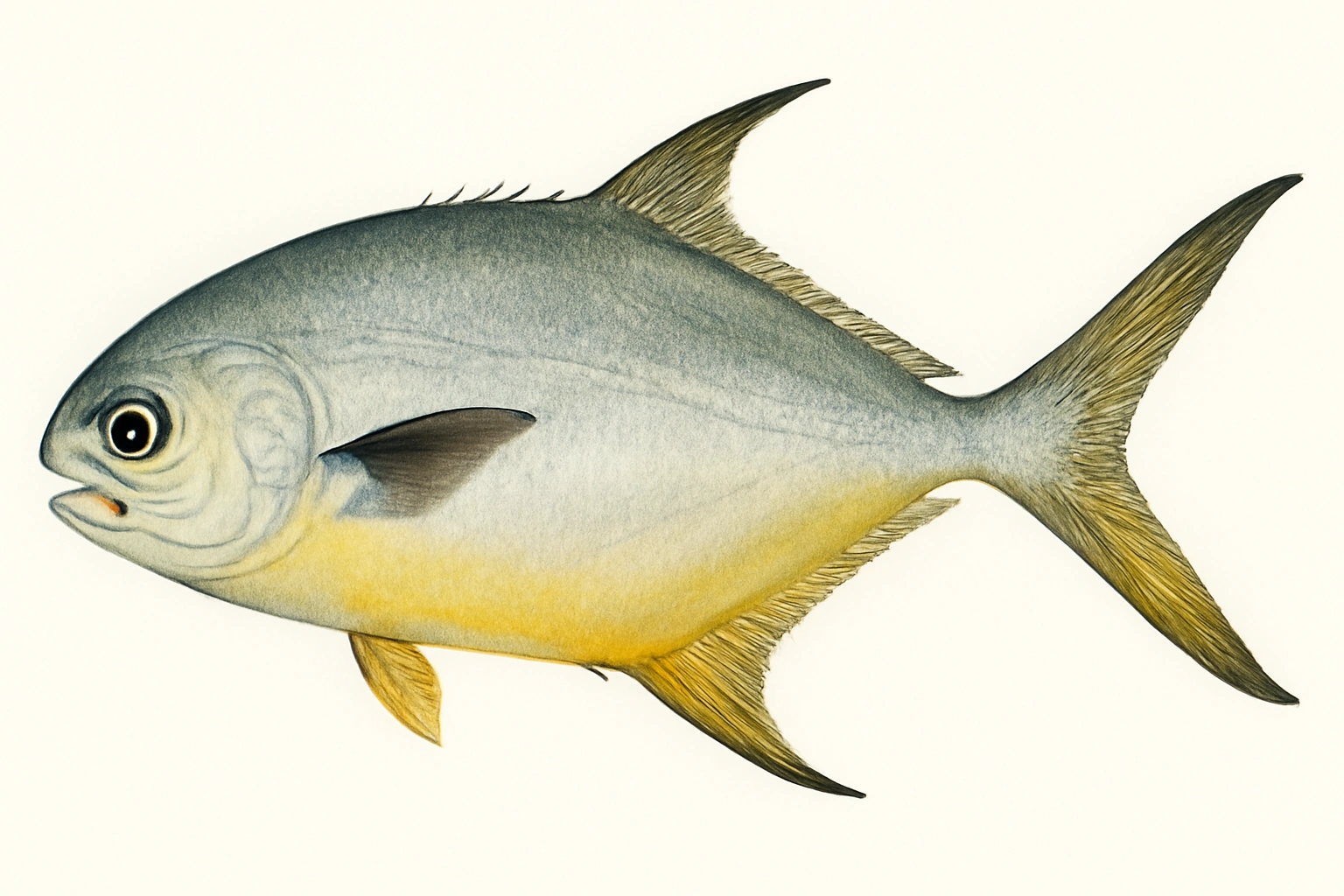
- Body laterally compressed with strongly developed dorsal and anal fins.
- Colouration
- Silvery body with golden hues, with fins that are darker towards the edges.
- Sexual dimorphism
- Absent/not very apparent
- Growth
- Rapid, especially in the first year of life
Taxonomy
- Family
- Carangidae
- Order
- Perciformes
- Class
- Actinopterygii
Related species
Habitat & distribution
- Environment
- Coast, Open sea
- Preferred bottom
- Sand, Seagrass
- Geographic distribution
- Found along the Atlantic coasts of the United States, from Massachusetts to Texas, also common in the Gulf of Mexico waters.
- Micro-habitat
- Often found in surf zones, near sandy beaches where it searches for food.
Prefers sandy bottoms where it can dig for food.
Presence by sea area
Diet
- Primary prey
- crustaceans, bivalves, small fish
- Secondary prey
- shrimp, polychaetes, seaweed
- Occasional prey
- aquatic insects, plankton
- Feeding behaviour
- Primarily feeds during the day, often following the waves to find prey in the sand.
- Natural predators
- sharks, barracuda, tuna
Adapts its diet based on local prey availability.
Behaviour
- Activity
- diurnal
- Social behaviour
- small_groups
- Aggressiveness
- low
- Migration
- Performs seasonal migrations related to water temperature.
- Seasonal behaviour
- Migrations occur towards warmer waters in winter and cooler waters in summer.
- Juveniles
- Juveniles form small groups in shallow waters near the shore.
- Adults
- Adults may be found farther offshore but often return to coastal areas for feeding.
Reproduction
- Spawning season
- May, June, July
- Spawning depth
- between 20 and 60 meters
- Eggs
- Pelagic, transparent, small-sized eggs
- Larval stage
- Larvae are transparent and highly dispersed by currents.
- Sexual maturity
- varies between 2 and 3 years
When to catch Florida pompano
Activity calendar
Activity by season
Best times
This species shows peak fishing activity in spring, summer and autumn, when the productivity index (FPI) reaches its highest values.
Fishing activity decreases in winter, when conditions are less favourable.
Ideal conditions
Atmospheric pressure
Very active in the surf.
Feeds regularly.
Less active, moves away from shore.
Declining bite.
Good surf zone activity.
Excellent, frantic bite.
Water temperature
Where to catch it
Best spots
Bottom preference
Spot type
Fishing techniques
Recommended
Other applicable
Recommended baits
Baits by pressure
How to really catch it
Silvery, compact, and lively without being reckless, the Florida pompano is one of those fish that can turn a wave-washed beach into a real hunting ground. When it starts feeding in the surf, with those long falcate fins and that bright body, it becomes immediately clear why so many anglers chase it so persistently.
🐟 Good to know
One real and useful biological trait is its pelagic reproduction: from May to July it releases small, transparent, floating eggs between 20 and 60 meters, and the larvae are then widely dispersed by currents. It is a detail that clearly shows how this species is tied both to the coast and to open water.
🌊 Where & when
You find it along sandy coasts, seagrass areas, river mouths, low rocky shores, and harbor entrances, from very shallow water down to 60 meters, but its most practical face is in the surf zone close to the beach. It is a daytime species, often in small groups, with especially good chances from March to November; it also makes seasonal migrations, moving toward warmer water in winter and cooler water in summer.
🎣 How to really catch it
If you want to catch it for real, surfcasting from sandy beaches is the most reliable route: work the band where the wave breaks and then pulls back, because that is where it searches the bottom for crustaceans, bivalves, and shrimp. A sturdy spinning rod, 8-12 lb main line, 20 lb fluorocarbon leader, a 1/0 circle hook, and a pyramid or egg sinker give you a clean setup; as bait, shrimp and pieces of crab are the most consistent with its diet.
💡 The detail that makes the difference
The most defensible little secret is simple: do not insist too far out when the beach has an active surf line. Florida pompano feed during the day by following waves to find prey in the sand, so placing the bait in water worked by the surf, rather than beyond it, often means putting it exactly where the fish is already searching.
Catch & handling tips
- Fight
- Offers lively and fast resistance, with quick runs and sudden changes in direction.
- Handling
- Use wet gloves to avoid damaging the scales.
- Release
- Release immediately, preferably without removing it from the water.
Curiosities & culture
- Record catches
- Maximum documented size: up to about 64 cm and 3.8 kg (source: FishBase). IGFA All-Tackle record: 3.76 kg (8 lb 4 oz), caught at St. Joe Bay, Florida (USA), in 1999.
- In the kitchen
- White, flavorful meat used in dishes like baked or grilled pompano.
- Cultural notes
- Highly valued in sport-fishing competitions for its speed and strength.
- Historical notes
- Traditionally caught by Native Americans along the Florida coast.