
Overview
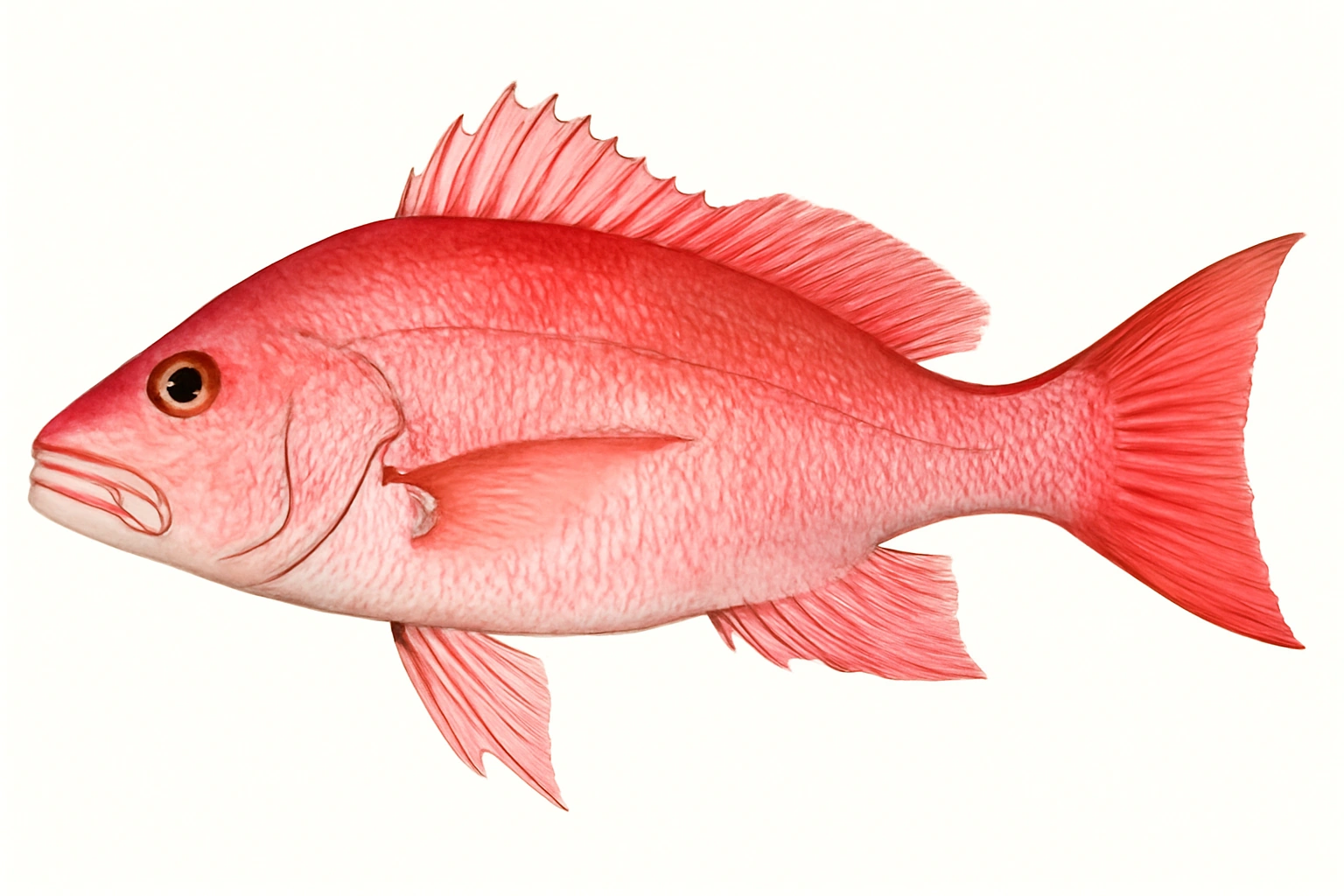
Iconic reef fish of the Gulf of Mexico. Prized meat, lives near submerged structures and wrecks.
Identification
- Body
- The body is fusiform and sturdy, with a large mouth and relatively small eyes.
- Colouration
- It has a bright red coloration, with some scattered white spots on the sides, and a lighter belly.
- Sexual dimorphism
- absent/not noticeable
- Growth
- fast, grows quickly in the first years of life
Taxonomy
- Family
- Lutjanidae
- Order
- Perciformes
- Class
- Actinopterygii
Related species
Habitat & distribution
- Environment
- Coast, Reefs, Open sea
- Preferred bottom
- Reef, Rock, Sand
- Geographic distribution
- Primarily in the Gulf of Mexico and along the western Atlantic coast up to Massachusetts.
- Micro-habitat
- Often found near submerged structures like wrecks and artificial reefs.
Prefers structured areas where it can hide and hunt.
Presence by sea area
Diet
- Primary prey
- crustaceans, small fish, mollusks
- Secondary prey
- squid, jellyfish, shrimp
- Occasional prey
- algae, zooplankton
- Feeding behaviour
- It is an opportunistic predator that hunts both day and night, using structures in its habitat to ambush prey.
- Natural predators
- sharks, large groupers, dolphins
Opportunistic, feeds primarily where prey is abundant.
Behaviour
- Activity
- diurnal
- Social behaviour
- small_groups
- Aggressiveness
- medium
- Migration
- residential
- Seasonal behaviour
- More active in nesting areas during summer, while in winter it moves to deeper waters.
- Juveniles
- Juveniles often form small groups near the coast.
- Adults
- Adults tend to frequent deeper areas and form smaller groups.
Reproduction
- Spawning season
- May, June, July, August
- Spawning depth
- between 30 and 60 meters
- Eggs
- Pelagic, small, and transparent eggs.
- Larval stage
- Larvae are pelagic and develop quickly before settling in more structured habitats.
- Sexual maturity
- 3-4 years
When to catch Red snapper
Activity calendar
Activity by season
Best times
This species shows peak fishing activity in spring, summer and autumn, when the productivity index (FPI) reaches its highest values.
Fishing activity decreases in winter, when conditions are less favourable.
Ideal conditions
Atmospheric pressure
Feeds actively near structures.
Regular activity.
Goes to bottom, less active.
Less active, stays near bottom.
Good activity near structures.
Very active, feeds aggressively.
Water temperature
Where to catch it
Best spots
Bottom preference
Spot type
Fishing techniques
Recommended
Other applicable
Recommended baits
Baits by pressure
How to really catch it
The red snapper is one of the key deep-structure targets: a robust, bright-red fish with a large mouth and a habit of holding where the bottom offers cover and ambush points. When you look for it over wrecks, reefs, or mixed bottom, the feeling is always the same: beneath the boat a clean bite can turn instantly into a hard run back toward the bottom.
🐟 Good to know
An important biological trait of red snapper is its pelagic larval phase: after hatching, the larvae live in open water and only later settle into more structured habitats. The eggs are pelagic as well, small and transparent, a detail that helps explain the strong association of adults with reefs, rocks, and submerged structure.
🌊 Where & when
It lives primarily in the Gulf of Mexico and along the western Atlantic coast up to Massachusetts, across coastal waters, reefs, and open sea, over rock, sand, and reef bottom, often near wrecks and artificial reefs. It is fishable through a long season, with a peak from March to November; in summer it is more active in spawning areas between 30 and 60 meters, while in winter it tends to move deeper.
🎣 How to really catch it
For red snapper, heavy bottom fishing is the most practical and dependable approach. Picture the rig dropping straight down beside a wreck or along the hard edge of a reef, built with a 40 lb fluorocarbon leader, 4/0-6/0 circle hooks, and a quick-release sinker, presenting fresh sardines, squid, shrimp, or small live baitfish tight to the structure where this opportunistic predator commonly feeds.
💡 The detail that makes the difference
The most defensible tip is simple: as soon as you feel the bite, stay in control and do not give too much room to the first dive. Red snapper often tries to drive back toward the bottom and cover once hooked; fishing perfectly vertical over structure and keeping the rig compact helps reduce contact with rocks, wrecks, and hard edges.
Catch & handling tips
- Fight
- A vigorous fighter, it tends to swim quickly towards the bottom to escape.
- Handling
- Use a cloth or gloves to avoid injury from dorsal spines.
- Release
- Release quickly, preferably without removing from the water.
Curiosities & culture
- Record catches
- Maximum documented size: up to about 100 cm and 22.8 kg (source: FishBase). IGFA All-Tackle record: 22.79 kg (50 lb 4 oz), caught in the Gulf of Mexico in 1996.
- In the kitchen
- The meat is delicate and can be grilled, baked, or fried, a common ingredient in Cajun cuisine.
- Cultural notes
- Highly valued in Southern U.S. culinary culture, often associated with traditional seafood dishes.
- Historical notes
- Red snapper has historically been vital for fishing communities in the Gulf of Mexico, both for personal consumption and trade.