
Overview
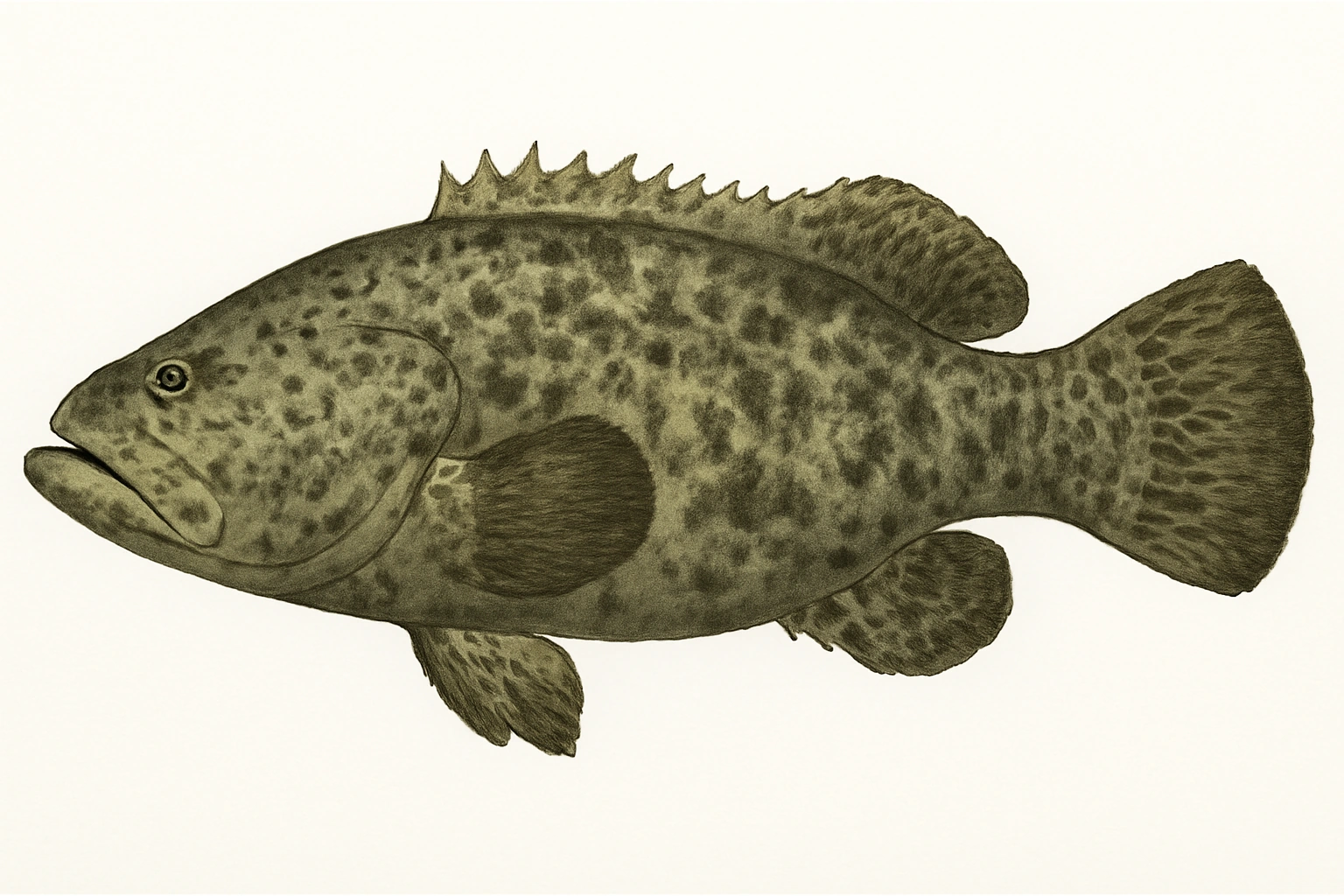
The largest Atlantic grouper, can exceed 300 kg. Imposing predator of tropical reefs and wrecks.
Identification
- Body
- Solid and robust body with a rounded profile.
- Colouration
- Color varies from olive green to brown, often with dark spots and faded vertical bands.
- Sexual dimorphism
- Absent/Not noticeable
- Growth
- Slow, reaches sexual maturity late.
Taxonomy
- Family
- Serranidae
- Order
- Perciformes
- Class
- Actinopterygii
Related species
Habitat & distribution
- Environment
- Coast, Reefs, Estuaries
- Preferred bottom
- Reef, Rock, Sand
- Geographic distribution
- Common in the western Atlantic and Gulf of Mexico, also found in parts of the Caribbean Sea.
- Micro-habitat
- Often found near wrecks and submerged structures where it can shelter and hunt.
Prefers environments rich in shelters to protect from predators and get closer to prey.
Presence by sea area
Diet
- Primary prey
- crustaceans, small fish, cuttlefish
- Secondary prey
- octopus, lobster, crabs
- Occasional prey
- small sharks, rays
- Feeding behaviour
- An opportunistic hunter that uses its large mouth to suck in prey in a single strike.
- Natural predators
- large sharks, humans, orca
Hunter preferring easy and abundant prey, using its significant mouth to trap them.
Behaviour
- Activity
- diurnal
- Social behaviour
- solitary
- Aggressiveness
- medium
- Migration
- Usually sedentary, but young individuals may move to find new territories.
- Seasonal behaviour
- Tends to gather in specific areas for mating during the breeding season.
- Juveniles
- Juveniles prefer shallow mangrove zones and wrecks for shelter.
- Adults
- Adults are more territorial, preferring deeper and more established wrecks.
Reproduction
- Spawning season
- May, June, July
- Spawning depth
- between 20 and 60 meters
- Eggs
- Small pelagic eggs with high transparency.
- Larval stage
- Larvae disperse in plankton before settling on suitable substrates like mangroves.
- Sexual maturity
- 5-7 years
When to catch Goliath grouper
Activity calendar
Activity by season
Best times
This species shows peak fishing activity in spring, summer and autumn, when the productivity index (FPI) reaches its highest values.
Fishing activity decreases in winter, when conditions are less favourable.
Ideal conditions
Atmospheric pressure
Very active, comes out in the open.
Stays near structures.
Stays hidden in structures.
Stays in structures.
Regular activity.
More aggressive.
Water temperature
Where to catch it
Best spots
Bottom preference
Spot type
Fishing techniques
Recommended
Other applicable
Recommended baits
Baits by pressure
How to really catch it
The goliath grouper is an imposing presence around wrecks and reefs: massive, slow-moving, yet able to vanish in a single surge back into the structure it claims as its own. If you want to target it for real, you have to step into its world of shadow, metal, and rock, where every mistake gives it instant shelter.
🐟 Good to know
An important biological feature of the species is its juvenile life cycle: larvae disperse in plankton, then young fish settle in sheltered habitats such as mangroves before moving toward wrecks and more stable structures as they grow. This link between different environments is a real part of its life history.
🌊 Where & when
It lives along coasts, reefs, and estuaries, from very shallow water down to 100 meters, with a strong preference for wrecks, rocks, mixed bottoms, and submerged structures where it can shelter and hunt. It is especially worth targeting from March to November; from May to July it also tends to gather in spawning areas between 20 and 60 meters.
🎣 How to really catch it
The most concrete way to fish for it is bottom fishing over wrecks, reefs, or artificial structures, dropping a large, believable natural bait right beside the cover. Live fish, squid, octopus, and crustaceans make biological sense for an opportunistic predator that sucks prey in with its wide mouth. You need a heavy deep-water rod, 50-100 lb braided line, an 80-150 lb steel leader, large circle hooks, and a heavy bottom sinker.
💡 The detail that makes the difference
The detail that makes the difference is precision: do not fish vaguely “on the wreck,” but on the usable edge of the shelter, where the grouper can move out to feed without leaving cover and territory. It is a solitary, territorial fish, and once hooked it tries immediately to dive back into its hole: that is why instant control matters more than finesse.
Catch & handling tips
- Fight
- Powerful and combative, it attempts to retreat into its lairs.
- Handling
- Handle with care due to its strength; avoid hands near its mouth.
- Release
- Release quickly to reduce stress and promote survival.
Curiosities & culture
- Record catches
- Maximum documented size: up to about 250 cm and 455 kg (source: FishBase). IGFA All-Tackle record: 308.44 kg (680 lb), caught by Lynn Joyner at Fernandina Beach, Florida (USA), in 1961.
- In the kitchen
- Dense flesh used in baked or grilled fish dishes, typical of Caribbean regions.
- Cultural notes
- Symbol of strength in Caribbean myths, often featured in sea legends.
- Historical notes
- Famous in the past for sport fishing before conservation regulations.