
Overview
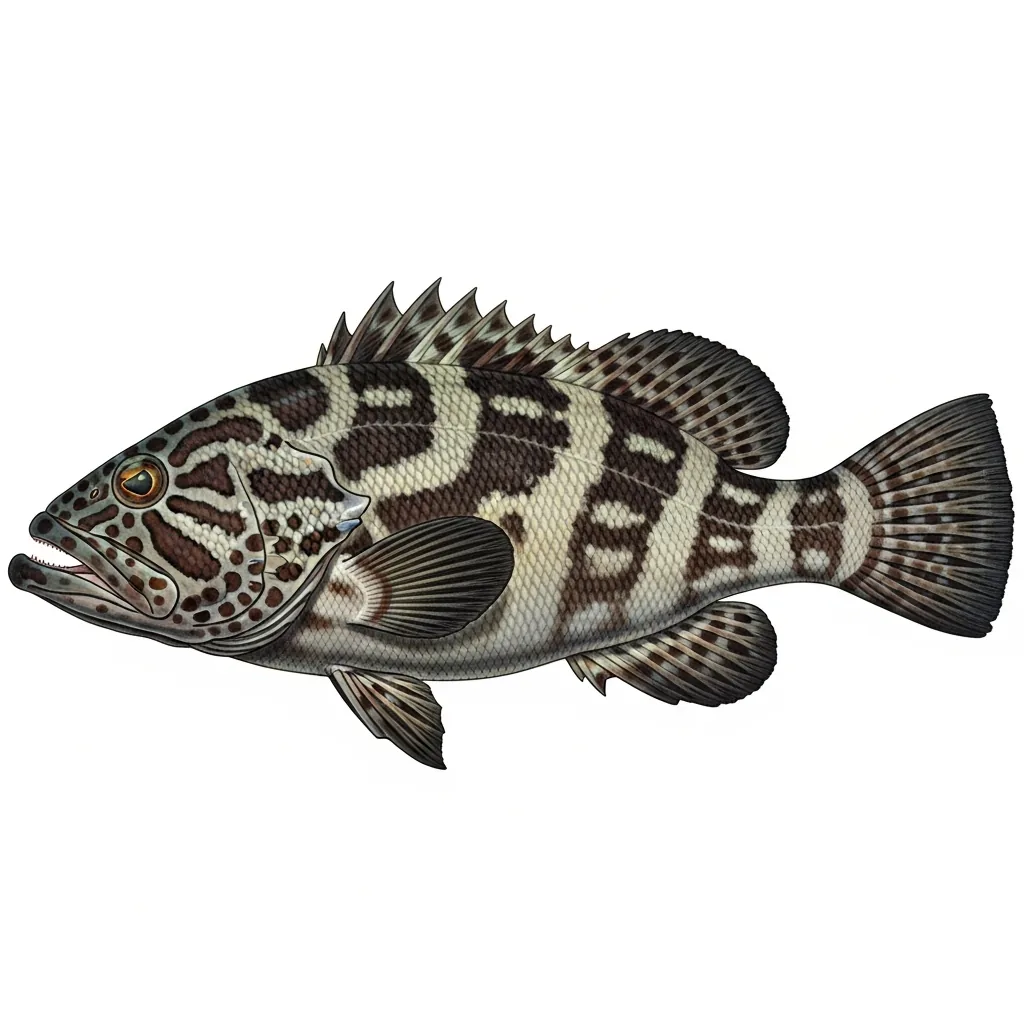
One of the most prized groupers in the Gulf of Mexico. Powerful fighter living among rocky structures.
Identification
- Body
- Long, robust body with a massive head.
- Colouration
- Mainly gray-brown with irregular patches that merge into dark bands.
- Sexual dimorphism
- Absent/Not noticeable
- Growth
- Moderate, faster growth in the early years.
Taxonomy
- Family
- Serranidae
- Order
- Perciformes
- Class
- Actinopterygii
Related species
Habitat & distribution
- Environment
- Coast, Open sea, Reefs
- Preferred bottom
- Rock, Gravel, Reef
- Geographic distribution
- Widespread in the western Atlantic Ocean, from Massachusetts to Brazil; common in the Gulf of Mexico.
- Micro-habitat
- Often hides among rocky structures and reefs, using cavities and crevices.
Coral reefs provide ideal shelter and feeding opportunities.
Presence by sea area
Diet
- Primary prey
- small fish, squid, octopus
- Secondary prey
- crabs, shrimp, shellfish
- Occasional prey
- eels, rays
- Feeding behaviour
- Actively ambushes prey among rocks and coral reefs and uses its powerful mouth to suck in prey.
- Natural predators
- sharks, large barracuda, amberjacks
Prefers to ambush prey, taking advantage of habitat cover.
Behaviour
- Activity
- diurnal
- Social behaviour
- solitary
- Aggressiveness
- medium
- Migration
- Seasonal migration from open sea to coastal areas during warmer months.
- Seasonal behaviour
- With rising temperatures, approaches coasts and becomes more active in hunting.
- Juveniles
- Juveniles prefer coastal and more sheltered areas.
- Adults
- Adults occupy larger territories, often near deep rocky structures.
Reproduction
- Spawning season
- May, June, July
- Spawning depth
- between 20 and 50 meters
- Eggs
- Pelagic eggs that are very small.
- Larval stage
- Larvae are planktonic and grow rapidly in nutrient-rich areas.
- Sexual maturity
- 3-5 years
When to catch Gag Grouper
Activity calendar
Activity by season
Best times
This species shows peak fishing activity in spring, summer and autumn, when the productivity index (FPI) reaches its highest values.
Fishing activity decreases in winter, when conditions are less favourable.
Ideal conditions
Water temperature
Where to catch it
Best spots
Bottom preference
Spot type
Fishing techniques
Recommended
Other applicable
Recommended baits
Baits by pressure
How to really catch it
The gag grouper is a powerful, elongated, wary serranid built to live tight to rock and reef. But when it decides to feed, it does so like a true ambush predator: understanding where it holds is the key that turns an ordinary bottom into a memorable encounter.
🐟 Good to know
Like many groupers, the gag is born female and can change sex as it grows: a documented case of protogynous hermaphroditism. This part of its biology makes reproductive stock and the presence of large individuals especially important within the population.
🌊 Where & when
You find it over rock, gravel, and reef bottoms, from coast to offshore reefs, in 5 to 150 meters, often tucked into cavities and crevices. In the western Atlantic, from Massachusetts to Brazil and especially common in the Gulf of Mexico, it moves closer to shore in warmer months and becomes more active from spring into autumn; from May to July it spawns between 20 and 50 meters.
🎣 How to really catch it
The most concrete way to target it is vertical bolentino or bottom fishing over wrecks, cliffs, coral reefs, and continental shelf edges, keeping the bait working close to living bottom. Sardines, squid, octopus, and small baitfish match its diet well; a powerful 20-40 lb rod, 30-50 lb braid, 60-80 lb fluorocarbon leader, 4/0-6/0 circle hooks, and 200-400 g egg sinkers help keep it out of the rocks once it commits.
💡 The detail that makes the difference
The most defensible practical tip is this: focus your drops on the side of the structure that offers cracks, edges, and shade on the bottom, not in the empty water around it. Gag grouper ambushes prey among rocks and reefs and usually dives straight back into cover; if your bait travels too far from that shelter, it is often outside its natural attack lane.
Catch & handling tips
- Fight
- Strong and resilient fighter, tends to seek refuge among the rocks.
- Handling
- Use gloves to avoid injury from fin spines.
- Release
- Release at proper depth to avoid barotrauma.
Curiosities & culture
- Record catches
- Maximum documented size: up to about 145 cm and 36.5 kg (source: FishBase). IGFA All-Tackle record: 36.46 kg (80 lb 6 oz), caught by Bill Smith at Destin, Florida (USA), in 1993.
- In the kitchen
- Highly valued in cuisine for its white meat, used in dishes like grilled grouper and fish stews.
- Cultural notes
- Often featured in Caribbean sport-fishing tales.
- Historical notes
- Traditionally fished by hand in Gulf of Mexico communities for centuries.