
Overview
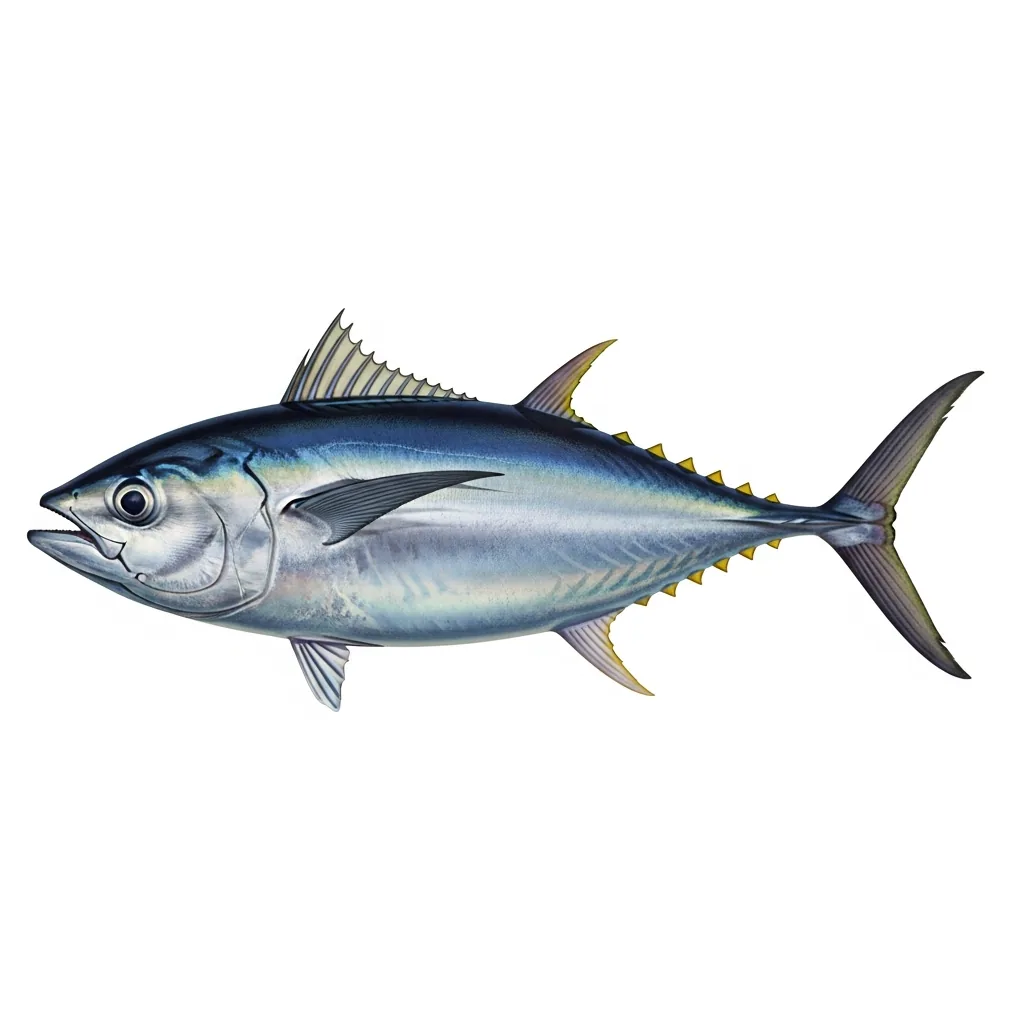
Extremely powerful tropical tuna that lives near deep reefs.
Identification
- Body
- The body is elongated and hydrodynamic, typical of large pelagic predators.
- Colouration
- The back is dark blue with a silvery sheen on the sides and belly.
- Sexual dimorphism
- Absent/barely noticeable
- Growth
- Medium, grows quickly in the first years of life
Taxonomy
- Family
- Scombridae
- Order
- Scombriformes
- Class
- Actinopterygii
Related species
Habitat & distribution
- Environment
- Coast, Reefs, Open sea
- Preferred bottom
- Reef, Rock
- Geographic distribution
- Lives in the tropical and subtropical waters of the Indo-Pacific Ocean, from the eastern African coast to the Pacific islands.
- Micro-habitat
- Inhabits deep reefs and seeks shelter in rock crevices during hunting.
Prefers reefs for their abundance of prey and hiding spots.
Presence by sea area
Diet
- Primary prey
- flying fish, mackerel, jacks
- Secondary prey
- squid, cuttlefish, small pelagic fish
- Occasional prey
- shrimp, jellyfish
- Feeding behaviour
- Aggressive and solitary hunter, strikes its prey with sudden bursts.
- Natural predators
- sharks, larger tuna, marlin
Diet varies depending on the season and prey availability.
Behaviour
- Activity
- diurnal
- Social behaviour
- solitary
- Aggressiveness
- high
- Migration
- Resident but may make short moves in search of food.
- Seasonal behaviour
- More active during warmer months, with activity peaks during the growth season.
- Juveniles
- Juveniles tend to stay closer to reef shelters.
- Adults
- Adults are often solitary and swim in open waters.
Reproduction
- Spawning season
- March, April, May
- Spawning depth
- between 20 and 60 meters
- Eggs
- Small pelagic eggs
- Larval stage
- The larvae are pelagic and feed on plankton until developing sufficient mobility to hunt.
- Sexual maturity
- varies between 4 and 6 years
When to catch Dogtooth tuna
Activity calendar
Activity by season
Best times
This species shows peak fishing activity in spring, summer and autumn, when the productivity index (FPI) reaches its highest values.
Fishing activity decreases in winter, when conditions are less favourable.
Ideal conditions
Atmospheric pressure
Actively hunts along the reef.
Regular activity.
Deeper and more selective.
Water temperature
Where to catch it
Best spots
Bottom preference
Spot type
Fishing techniques
Recommended
Other applicable
Recommended baits
Baits by pressure
How to really catch it
Dogtooth tuna is a true pelagic predator: long, taut, armed with obvious teeth, and built for sudden attacks around reefs and submerged drop-offs. When it appears on the blue edge, often alone, it gives you very little time to think; that mix of power and abrupt violence is exactly what makes it unforgettable.
🐟 Good to know
Unlike many fast-bodied fishes, dogtooth tuna has a body that is essentially without obvious scales, a real and unusual trait among large pelagic predators. It also has large eyes and a clearly defined lateral line, details consistent with active hunting in open water and along deep structure.
🌊 Where & when
It is found in the tropical and subtropical Indo-Pacific, from the eastern coast of Africa to the Pacific islands, especially near deep reefs, submerged rocky structure, offshore pinnacles, and open water from 10 to 300 meters. It becomes more fishable in the warmer months, with a broad window from March to November; from March to May it is also in its spawning period, with spawning between 20 and 60 meters.
🎣 How to really catch it
The most concrete approach is trolling around deep reefs and the edges of offshore structure, where this solitary hunter intercepts baitfish and squid with sudden attacks. Artificial squid, baitfish, and imitative lures make full biological sense given its diet; to handle a fast, erratic fight, use a powerful rod, 50-80 lb braid, and an 80-100 lb fluorocarbon leader, with metal jigs as a solid option when fish are holding deeper.
💡 The detail that makes the difference
One defensible trick is to work the sharp edges of structure rather than the flat top of the reef: this fish uses deep reefs, open water, and rocky cavities while hunting, so the key zone is often where rock ends and blue water begins. Whether trolling or jigging, bring the lure close to that abrupt transition.
Catch & handling tips
- Fight
- Strong and unpredictable fight with fast and powerful runs.
- Handling
- Handle with care due to sharp teeth.
- Release
- Ensure quick release, preferably without removing it from the water.
Curiosities & culture
- Record catches
- Maximum documented size: up to about 248 cm and 131 kg (source: FishBase). IGFA All-Tackle record: 107.5 kg (236 lb 15 oz), caught by Jon Patten at Dar es Salaam (Tanzania) in 2015.
- In the kitchen
- Delicious meat in sashimi and grilled recipes.
- Cultural notes
- Considered a challenge for sport fishermen due to its strength and speed.
- Historical notes
- Traditionally caught by local communities for its food and sport value.