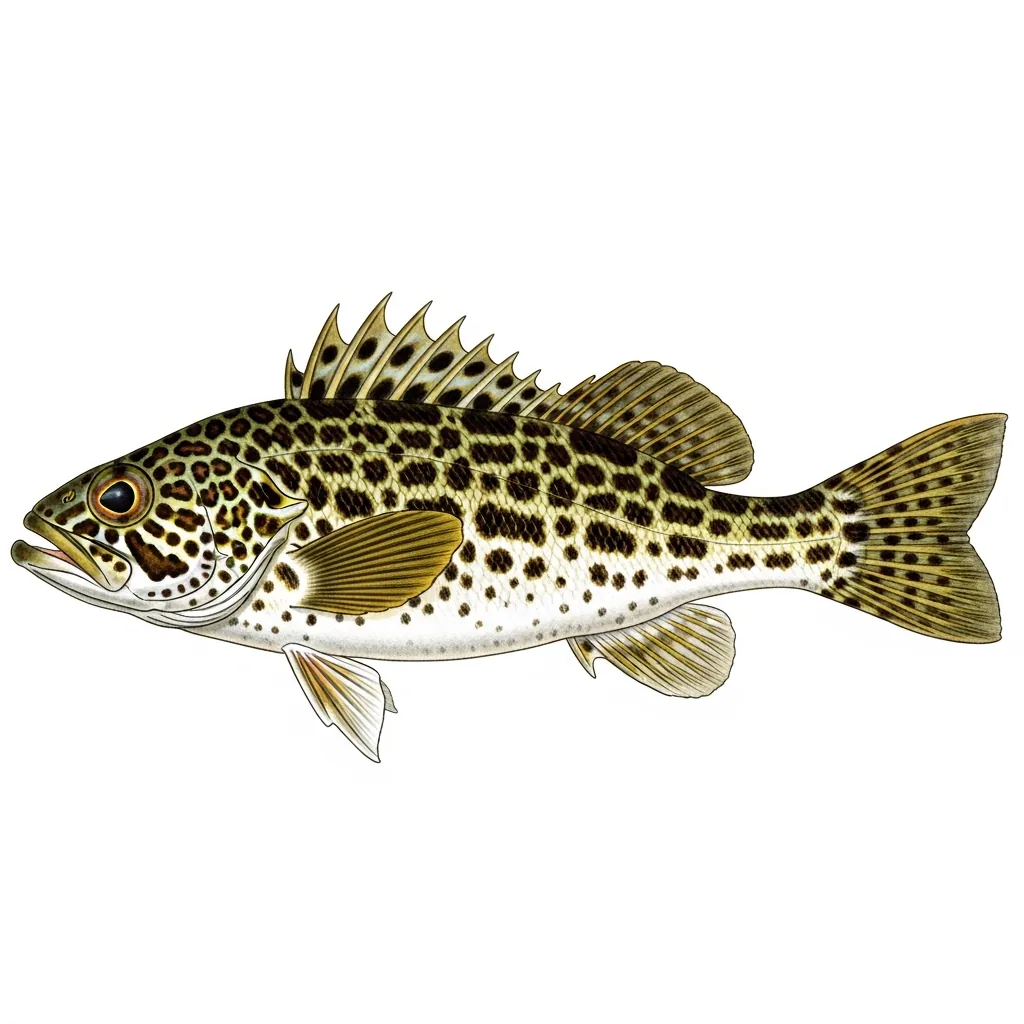

Overview
Also known as 'Calico Bass', the most common and popular fish in California kelp forests.
Identification
- Body
- The body is elongated and laterally compressed with a large head and wide mouth.
- Colouration
- Variable coloring with shades of brown, green, and yellow, with dark spots along the sides.
- Sexual dimorphism
- Absent/not noticeable
- Growth
- fast, reaches maturity in a few years
Taxonomy
- Family
- Serranidae
- Order
- Perciformes
- Class
- Actinopterygii
Related species
Habitat & distribution
- Environment
- Coast, Reefs, Kelp forests
- Preferred bottom
- Rock, Reef, Kelp
- Geographic distribution
- Found along the Pacific coast of California down to the Baja California peninsula and the Gulf of California.
- Micro-habitat
- Seeks refuge and hunts among dense kelp forests and underwater rocks.
Kelp forests offer both wave protection and abundant food.
Presence by sea area
Diet
- Primary prey
- small fish, crustaceans, squid
- Secondary prey
- shrimp, polychaetes, mollusks
- Occasional prey
- annelids, amphipods, fish eggs
- Feeding behaviour
- Opportunistic predator, mainly hunts during the day and uses the kelp environment to ambush prey.
- Natural predators
- sharks, sea lions, seabirds
Varied opportunistic diet that exploits available resources in its specific habitat.
Behaviour
- Activity
- diurnal
- Social behaviour
- solitary
- Aggressiveness
- medium
- Migration
- Stays in the same area, with small local movements.
- Seasonal behaviour
- Active year-round, may show activity peaks in summer when water temperatures are warmer.
- Juveniles
- Juveniles tend to hide among algae and rocks to avoid predators.
- Adults
- Adults are territorial and frequently remain in the same areas.
Reproduction
- Spawning season
- June, July
- Spawning depth
- between 5 and 20 meters
- Eggs
- Pelagic eggs, small and transparent.
- Larval stage
- Pelagic larvae drift with currents before settling in the kelp beds.
- Sexual maturity
- 3-4 years
When to catch Kelp Bass
Activity calendar
Activity by season
Best times
This species shows peak fishing activity in spring, summer and autumn, when the productivity index (FPI) reaches its highest values.
Fishing activity decreases in winter, when conditions are less favourable.
Ideal conditions
Water temperature
Where to catch it
Best spots
Bottom preference
Spot type
Fishing techniques
Recommended
Other applicable
Recommended baits
Baits by pressure
How to really catch it
The kelp bass is a coastal predator that seems built to vanish among weed blades and dark rock, then appear suddenly on its prey. If you want to catch it for real, you have to fish inside its maze: tight to kelp, close to the bottom, where any cast can turn into a hard, jittery run.
🐟 Good to know
An important biological trait of this species is its close link to kelp from early life onward: the larvae are pelagic and drift with the currents, then juveniles settle in kelp beds, where they find shelter among algae and rocks. That shift explains how central kelp is to its ecology.
🌊 Where & when
It lives along the Pacific coast of California down to Baja California and the Gulf of California, mainly over rock, reefs, and kelp forests from 2 to 50 meters. It is active year-round, but may become more aggressive in warm months; from March to November it remains highly fishable, with spawning from June to July between 5 and 20 meters.
🎣 How to really catch it
The most concrete way to target it is light spinning tight to kelp edges, cliffs, and submerged rock, letting a live bait or artificial work close to the cover where it tends to ambush prey. A light spinning rod with 8-15 lb main line and a 10-20 lb fluorocarbon leader gives control and stealth, while size 2-4 circle hooks and 1/4 to 1/2 oz weights help keep the presentation in the right zone.
💡 The detail that makes the difference
The practical secret is simple: if you contact a patch of kelp or a rock that just feels right, work it thoroughly instead of casting farther away. Adults are territorial and often remain in the same areas, so a second or third precise presentation beside the cover can trigger a fish that has not moved from its holding spot.
Catch & handling tips
- Fight
- Strong, fights vigorously with frequent runs and head shakes.
- Handling
- Handle carefully to avoid damage to fins and scales, use a wet cloth.
- Release
- Release into the water quickly and carefully to minimize stress risk.
Curiosities & culture
- Record catches
- Maximum documented size: up to about 72 cm and 7 kg (source: FishBase). There is no official IGFA All-Tackle record for this species.
- In the kitchen
- Used for seafood stews and steamed dishes, less common for raw consumption.
- Cultural notes
- Present in the local sport-fishing culture along the California coast.
- Historical notes
- Popular among sport-fishers due to its fighting spirit and presence in kelp forests.