
Overview
Very common species, loves reefs and mixed bottoms.
Identification
- Body
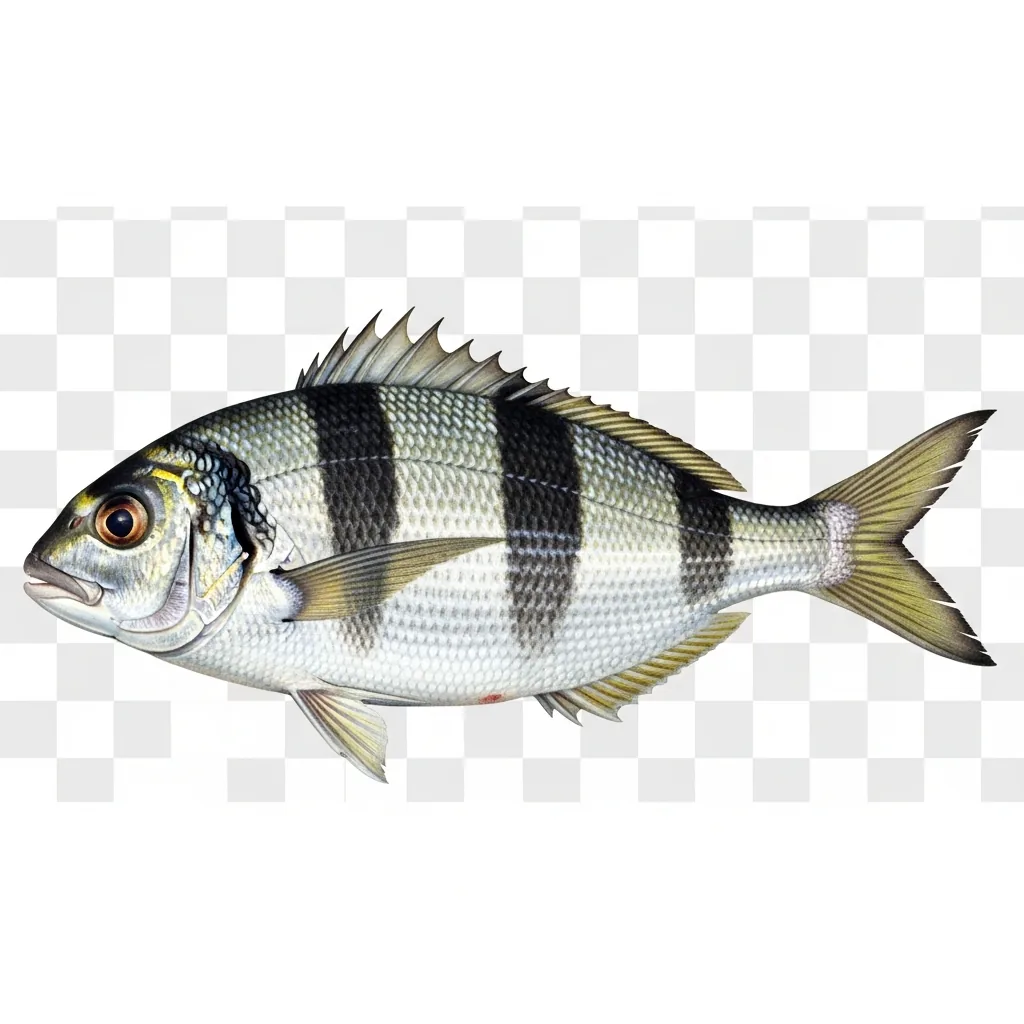
- Oval, laterally compressed body with a small mouth.
- Colouration
- Silvery coloration with black vertical stripes on the body.
- Sexual dimorphism
- Absent or not noticeable.
- Growth
- Moderate, reaches adult size in a few years.
Taxonomy
- Family
- Sparidae
- Order
- Perciformes
- Class
- Actinopterygii
Related species
Habitat & distribution
- Environment
- Coast, Reefs, Brackish
- Preferred bottom
- Rock, Gravel, Posidonia, Reef
- Geographic distribution
- Found in the Mediterranean Sea and along the eastern Atlantic coast down to South Africa.
- Micro-habitat
- Prefers rocky bottoms and seagrass beds, often found in tidal areas and reefs.
Favors areas with aquatic vegetation for shelter and feeding.
Presence by sea area
Diet
- Primary prey
- crustaceans, mollusks, polychaetes
- Secondary prey
- algae, detritus, small fish
- Occasional prey
- echinoderms, copepods
- Feeding behaviour
- Feeds during the day by grazing the substrate and among rocks for invertebrates.
- Natural predators
- groupers, moray eels, tunas, bluefish
Primarily grazes during the day using light to find food.
Behaviour
- Activity
- diurnal
- Social behaviour
- small_groups
- Aggressiveness
- low
- Migration
- Sedentary with small seasonal movements.
- Seasonal behaviour
- Tends to inhabit deeper waters in winter and more coastal areas in summer.
- Juveniles
- Young form small schools in shallow waters.
- Adults
- Adults may form small shoals or live alone on mixed bottoms.
Reproduction
- Spawning season
- April, May, June
- Spawning depth
- between 20 and 40 meters
- Eggs
- Small pelagic eggs.
- Larval stage
- Larvae are pelagic and move toward coastal areas as they grow.
- Sexual maturity
- 2-3 years
When to catch Two-banded sea bream
Activity calendar
Activity by season
Best times
This species shows peak fishing activity in spring, summer and autumn, when the productivity index (FPI) reaches its highest values.
Ideal conditions
Atmospheric pressure
Very active and less wary.
Regular activity.
Stays near rocks.
Normal activity, fewer surface bites.
Good conditions, feeds regularly.
Increases activity before bad weather. Good time to fish.
Water temperature
Where to catch it
Best spots
Bottom preference
Spot type
Fishing techniques
Recommended
Other applicable
Recommended baits
Baits by pressure
How to really catch it
The two-banded seabream is a compact, alert sparid, easy to recognize by the two black bars on its sides and its sturdy reef-fish profile. It lacks the violence of big predators, but when it rummages through rocks and seagrass it becomes a subtle, surprisingly technical target.
🐟 Good to know
The eggs of the two-banded seabream are pelagic, and the larvae also spend a phase in open water before moving toward the coast as they grow. It is an important part of its biology: a fish strongly tied to the bottom as an adult begins life suspended in the water column.
🌊 Where & when
It lives along coasts, reefs, rocky and gravel bottoms, and seagrass beds, from very shallow water down to about 50 meters, including brackish areas. It is most interesting from spring to autumn, when it tends to stay closer inshore; in winter it moves deeper. Spawning occurs from April to June, generally between 20 and 40 meters.
🎣 How to really catch it
To really catch it, the most solid approach is light bottom fishing or fine boat ledgering, placing the bait close to rocks, patches of seagrass, and mixed bottoms. Shrimp, annelids, and mussel are key baits for a species that feeds by day while searching the substrate for invertebrates. A light spinning rod, 0.20 main line, fluorocarbon leader, small thin hooks, and light round sinkers help keep the presentation natural.
💡 The detail that makes the difference
The detail that makes a difference is to fish tight to the bottom without making the rig too rigid: the two-banded seabream grazes and inspects among stones and vegetation, so a bait presented right on the spot works better than a heavy, static setup. If you find small groups feeding in daylight, it is worth insisting with accuracy along that same lane.
Catch & handling tips
- Fight
- Not particularly aggressive but makes short runs.
- Handling
- Handle carefully to avoid fin damage.
- Release
- Release quickly to ensure survival.
Curiosities & culture
- Record catches
- Maximum documented size: up to about 45 cm and 1.3 kg (source: FishBase). There is no official IGFA All-Tackle record for this species.
- In the kitchen
- Valued in cooking, often baked or grilled.
- Cultural notes
- Frequently part of the diets of Mediterranean coastal communities.
- Historical notes
- Historically, it was an important part of the diet for coastal populations.