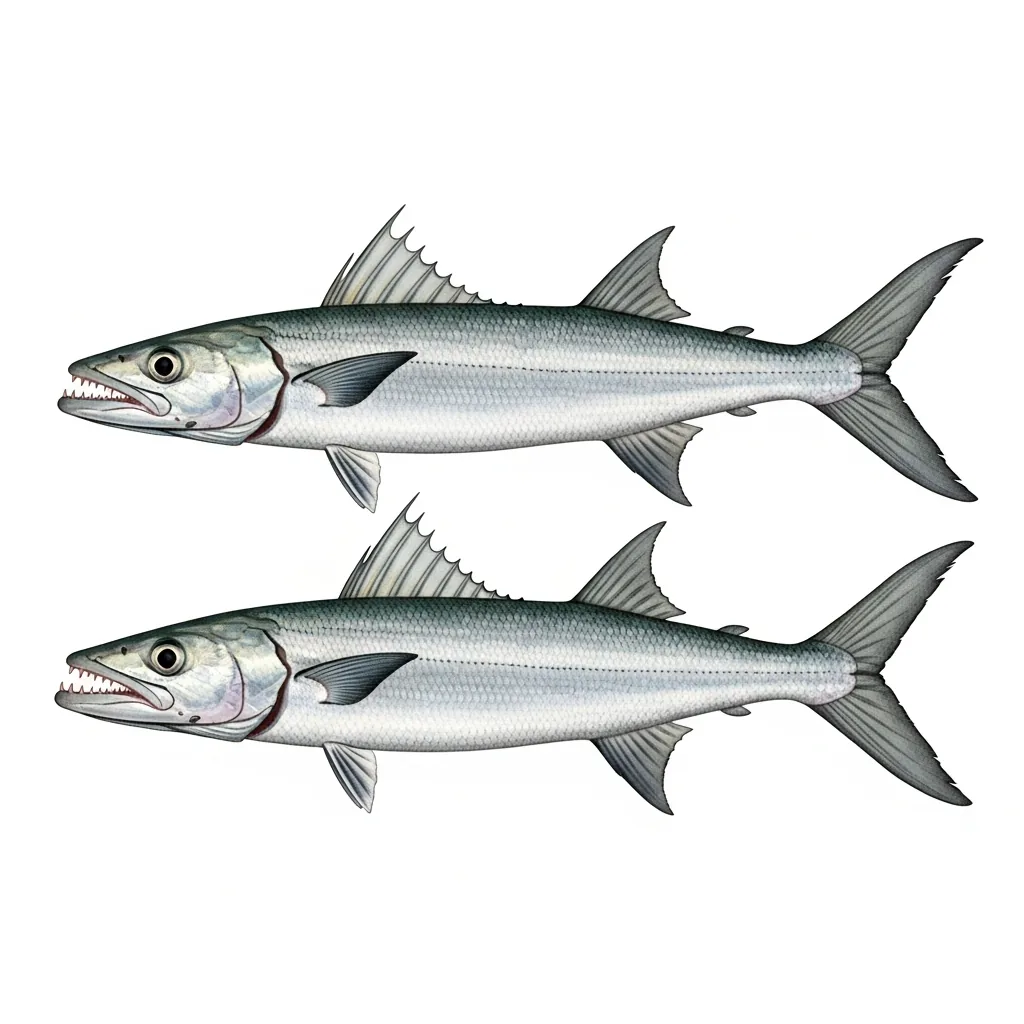

Overview
Fast predator of California coastal waters. Aggressively strikes both artificial and natural baits.
Identification
- Body
- Elongated and slender body with a pointed head.
- Colouration
- Silvery body with a series of dark stripes on the sides.
- Sexual dimorphism
- Absent/not pronounced
- Growth
- Fast, reaches adult size in a few years
Taxonomy
- Family
- Sphyraenidae
- Order
- Perciformes
- Class
- Actinopterygii
Related species
Habitat & distribution
- Environment
- Coast, Reefs
- Preferred bottom
- Sand, Rock, Reef
- Geographic distribution
- Found along the western coast of North America, from Baja California to Monterey Bay.
- Micro-habitat
- Prefers to hunt along reef edges and in shallow coastal waters.
Prefers environments where it can quickly hide and ambush prey.
Presence by sea area
Diet
- Primary prey
- smaller fish, cephalopods, crustaceans
- Secondary prey
- fish larvae, shrimp, krill
- Occasional prey
- small octopuses, jellyfish
- Feeding behaviour
- An opportunistic predator known for its swift attacks and ambush hunting.
- Natural predators
- sharks, tunas, large pelagic predators
Prefers quick attacks on isolated prey.
Behaviour
- Activity
- diurnal
- Social behaviour
- small_groups
- Aggressiveness
- high
- Migration
- Conducts seasonal migrations to different waters based on temperature and food availability.
- Seasonal behaviour
- Approaches the coast in spring and summer for breeding and hunting.
- Juveniles
- Young tend to stay close to the shore in homogeneous groups.
- Adults
- Adults may form small schools near reefs.
Reproduction
- Spawning season
- April, May, June
- Spawning depth
- between 5 and 15 meters
- Eggs
- Pelagic eggs, small and spherical, develop while drifting in water columns.
- Larval stage
- Larvae are transparent with a well-defined head and start to resemble adults after a few weeks.
- Sexual maturity
- 3-4 years
When to catch Pacific Barracuda
Activity calendar
Activity by season
Best times
This species shows peak fishing activity in spring, summer and autumn, when the productivity index (FPI) reaches its highest values.
Fishing activity decreases in winter, when conditions are less favourable.
Ideal conditions
Water temperature
Where to catch it
Best spots
Bottom preference
Spot type
Fishing techniques
Recommended
Other applicable
Recommended baits
Baits by pressure
How to really catch it
The Pacific barracuda is a living blade of the coastline: long-bodied, bright-sided, sharp-headed, with a mouth built to strike in a flash. When it starts hunting along reef edges, the water seems to hold its breath: understanding its rhythm and position makes all the difference.
🐟 Good to know
An important biological trait is its pelagic spawning: small, spherical eggs are released into the water column and develop while drifting. The larvae are initially transparent, then change quickly, and after a few weeks they already begin to resemble the adults.
🌊 Where & when
It is found along the western coast of North America, from Baja California to Monterey Bay, especially in shallow coastal water over sand, rock, and reefs, from 1 to 30 meters. It becomes more reachable from spring through autumn, moving closer to shore in spring and summer for feeding and breeding; from April to June it spawns between 5 and 15 meters.
🎣 How to really catch it
To truly fish for it, the most concrete approach is spinning or casting along coastal rocks, sheltered bays, harbor mouths, and especially near reefs, working artificial lures or small baitfish where it tends to ambush. A spinning or jigging rod, 20-30 lb braid, and a 40 lb fluorocarbon leader give control on the retrieve and security when it breaks away in fast runs and lateral surges.
💡 The detail that makes the difference
The detail that changes the day is reading the edge, not the middle: this barracuda prefers to hunt along reef margins and in shallow coastal water. Run the lure parallel to the break line between sand and structure, or beside the outer face of the rock: that is where an ambush predator watches prey pass and decides to strike.
Catch & handling tips
- Fight
- Fights hard and often attempts quick escapes and lateral darts.
- Handling
- Handle with care due to sharp teeth, use pliers to remove hooks.
- Release
- Quickly release back to water with gentle movements.
Curiosities & culture
- Record catches
- Maximum documented size: up to about 145 cm and 12 kg (source: FishBase). There is no clearly established IGFA All-Tackle record for this species.
- In the kitchen
- Flaky white meat, used for ceviche or grilling.
- Cultural notes
- In Californian pop culture, a symbol of aggressiveness and speed.
- Historical notes
- Historically fished by native Californian communities, once considered a sacred fish.